
Houston Dash W 1-4 Denver Summit W: Tactical Analysis
Houston Dash W’s 1-4 home defeat to Denver Summit W at Shell Energy Stadium unfolded as a structural mismatch between a rigid 4-4-2 and a fluid 4-2-3-1. In an NWSL Women group-stage tie where Denver edged possession 53% to 47% and doubled Dash’s total shots (14 to 7), the visitors repeatedly exploited vertical gaps between Houston’s midfield and back four. Despite a late first-half lifeline via a penalty, the Dash never solved Denver’s occupation of the half-spaces or their aggressive wing progression, and the second half became a controlled away performance rather than a contest.
Executive Summary
Denver’s 4-2-3-1, with Klara Melissa Kössler leading the line and a creative band of three behind, consistently pulled Houston’s 4-4-2 out of shape. Houston’s front two of Kate Faasse and Clarissa Larisey offered depth but little connective play, leaving the midfield quartet exposed in defensive transitions. The final scoreline of Houston Dash W 1-4 Denver Summit W accurately reflects Denver’s territorial control, superior shot volume, and ability to convert wide overloads into high-quality central chances.
Scoring Sequence & Disciplinary Log
Scoring unfolded in clear tactical phases.
- 15' — J. Sonis (Denver Summit W), assisted by Y. Ryan: Denver’s opener typified their use of the right half-space. Yazmeen Ryan, operating as a high interior playmaker, found J. Sonis attacking the left channel. The Dash’s flat back four was slow to shift, with full-backs pinned by wide threats, allowing Sonis to finish as the center-backs were split.
- 34' — N. Flint (Denver Summit W), unassisted: The second Denver goal reflected their dominance of second balls and box occupation. With Denver already ahead in shots inside the box (they finished with 9 to Houston’s 3), Natasha Flint capitalized on Houston’s inability to clear their lines, punishing a scrambled defensive shape.
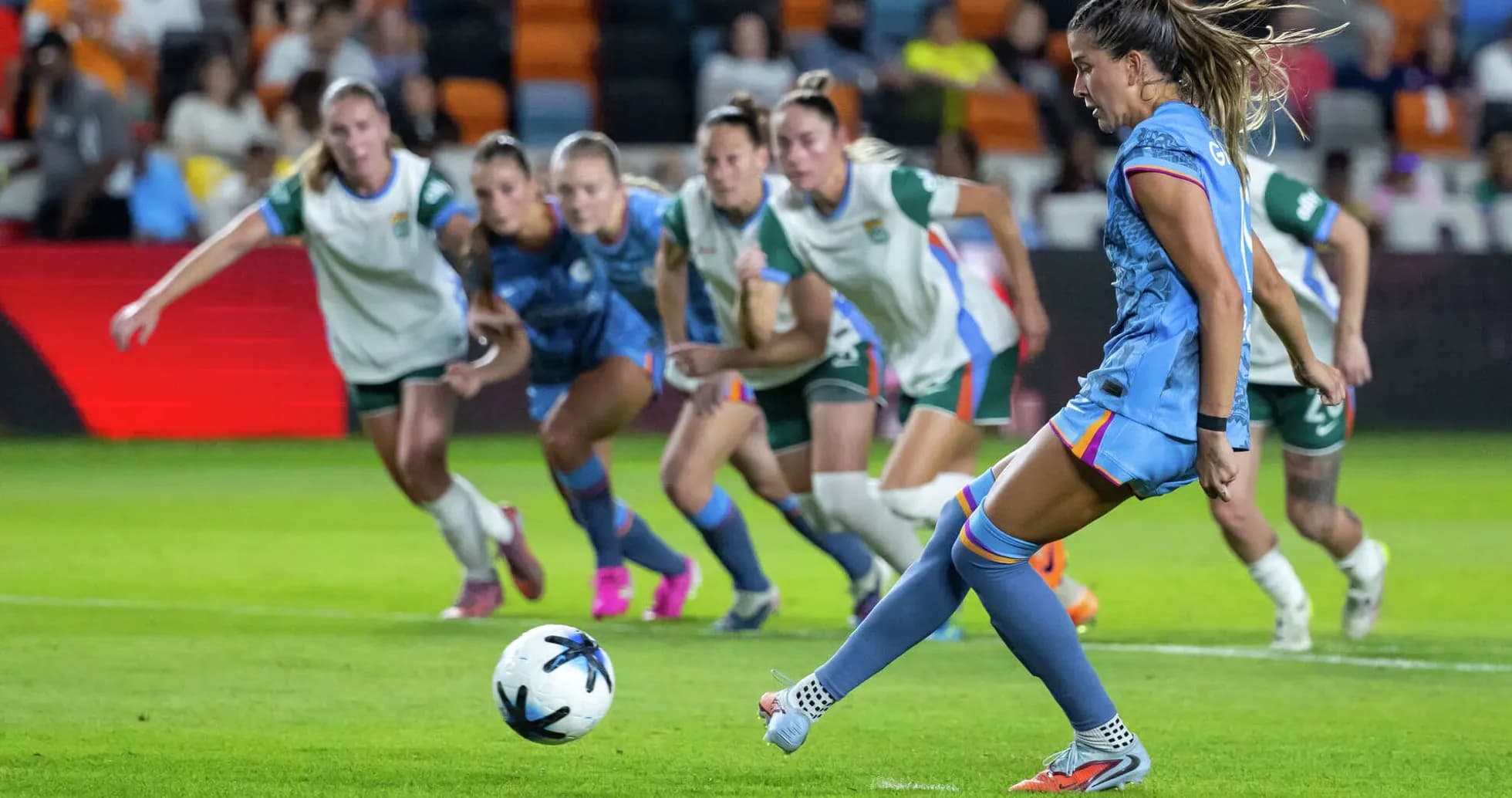
- 45' — M. Graham (Houston Dash W), penalty: Against the run of play, Maggie Graham converted from the spot to bring the halftime score to Houston Dash W 1-2 Denver Summit W. The goal did not materially change the pattern of play, but it briefly masked the structural problems in Houston’s midfield coverage.
- 49' — D. Sheehan (Denver Summit W), assisted by A. Oke: Early in the second half, right-back Ayo Oke advanced aggressively, stretching Houston’s left side. Her delivery found Delanie Sheehan arriving from a deeper midfield line, again exploiting the gap between Dash’s midfield and defensive units to restore a two-goal cushion.
- 72' — J. Sonis (Denver Summit W), assisted by Y. Ryan: The fourth goal completed a thematic loop. Ryan again linked play in the right half-space, and Sonis’ movement across the defensive line punished Houston’s lack of compactness. At 1-4, the contest was effectively settled.
Disciplinary log (all cards, in chronological order):
- 51' Danielle Colaprico (Houston Dash W) — Foul
- 74' Linda Ullmark (Houston Dash W) — Foul
Card totals: Houston Dash W: 2, Denver Summit W: 0, Total: 2. Denver’s discipline, despite committing more fouls (11 to Houston’s 5), remained card-free, underlining that Houston’s defensive strain manifested in more card-worthy interventions.
Tactical Breakdown & Personnel
Houston Dash W lined up in a classic 4-4-2 under Fabrice Gautrat. Jane Campbell in goal had 2 saves, matching Denver’s Abby Smith, but the shot profile she faced was far more dangerous: Denver produced 7 shots on goal from 14 total attempts, heavily concentrated inside the box (9 inside, 5 outside). Campbell’s defensive unit of Leah Klenke, Malia Berkely, Paige Nielsen, and Avery Patterson struggled to maintain vertical compactness, especially once Denver’s attacking midfielders began rotating.
Denver’s 4-2-3-1 used double pivots (Devin Lynch and Delanie Sheehan) to control central zones while freeing Ryan and Flint to attack pockets between Houston’s lines. Natasha Flint, nominally a midfielder, frequently joined Kössler to create temporary front-two structures, overloading Houston’s center-backs. This movement was central to the second goal and repeatedly forced Houston’s wide midfielders, Katherine Ann Rader and Linda Ullmark, into deep, reactive positions.
Houston’s midfield four—Rader, Colaprico, Graham, Ullmark—was outnumbered and out-positioned. Colaprico’s yellow card at 51' for “Foul” was emblematic: she often arrived late to challenges after Denver had already broken the initial line of pressure. Graham, while scoring the penalty, could not consistently connect midfield to attack; Houston finished with just 7 total shots and only 3 on target, highlighting their difficulty progressing the ball into threatening areas.
Substitutions were largely reactive for Houston. At 46', C. Larisey (OUT) was replaced as Mary Hardin (IN) came on, signaling a structural tweak from Gautrat, likely to stabilize the back line and push full-backs differently. At 62', D. Colaprico (OUT) made way as Sarah Puntigam (IN) came on, an attempt to add fresh legs and positional discipline in midfield after Colaprico’s booking. Later, at 78', L. Klenke (OUT) was replaced as Lisa Boattin (IN) came on, and L. Ullmark (OUT) was replaced as Emina Ekic (IN) came on, indicating a late push for more attacking thrust from wide areas. Finally, at 84', K. Faasse (OUT) was replaced as Messiah Bright (IN) came on, adding a more direct, physical forward presence, but by then Denver’s block was set and the score already 1-4.
Denver’s substitutions were more about energy management than structural change. At 59', A. Oke (OUT) was replaced as Yuna McCormack (IN) came on, preserving the aggressive right-sided role. At 60', N. Means (OUT) was replaced as Carson Pickett (IN) came on, adding a more experienced defensive presence. At 82', M. Kossler (OUT) was replaced as Olivia Thomas (IN) came on, and at 90', N. Flint (OUT) was replaced as Emma Regan (IN) came on—rotations that maintained the 4-2-3-1 shape while keeping intensity high.
The Statistical Verdict
The numbers reinforce the tactical story. Denver’s 424 passes, 349 accurate (82%), versus Houston’s 382 passes, 295 accurate (77%), show a modest edge in ball circulation, but the real difference lay in territory and shot quality. Denver converted their 53% possession into 14 shots (7 on goal, 4 blocked), with 9 inside the box, while Houston’s 7 shots (3 on goal, 2 blocked) were more speculative and less frequent.
Defensively, both goalkeepers recorded 2 saves, but Denver’s defensive index was superior: they limited Houston’s entries while committing 11 fouls without drawing a single card, indicating controlled aggression. Houston, with only 5 fouls but 2 yellow cards, showed a team frequently defending in emergency situations rather than within a stable block.
Overall form-wise, Denver Summit W demonstrated a coherent game model—structured build-up, targeted half-space occupation, and efficient finishing—while Houston Dash W’s 4-4-2 lacked the vertical compactness and midfield control needed to withstand a well-drilled 4-2-3-1. The 1-4 scoreline, home team first, is a faithful reflection of both tactical execution and statistical dominance.
Related News
Orlando Pride W vs Portland Thorns W: Playoff Showdown

San Diego Wave W vs Kansas City W Predicted Lineups: Team News for NWSL Women
Orlando Pride W vs Portland Thorns W Prediction: Key Stats and Betting Tips

San Diego Wave W vs Kansas City W: Key NWSL Clash Preview
San Diego Wave W vs Kansas City W Prediction: Key Stats and Betting Tips
Portland Thorns and Chicago Red Stars Draw in NWSL Showdown