
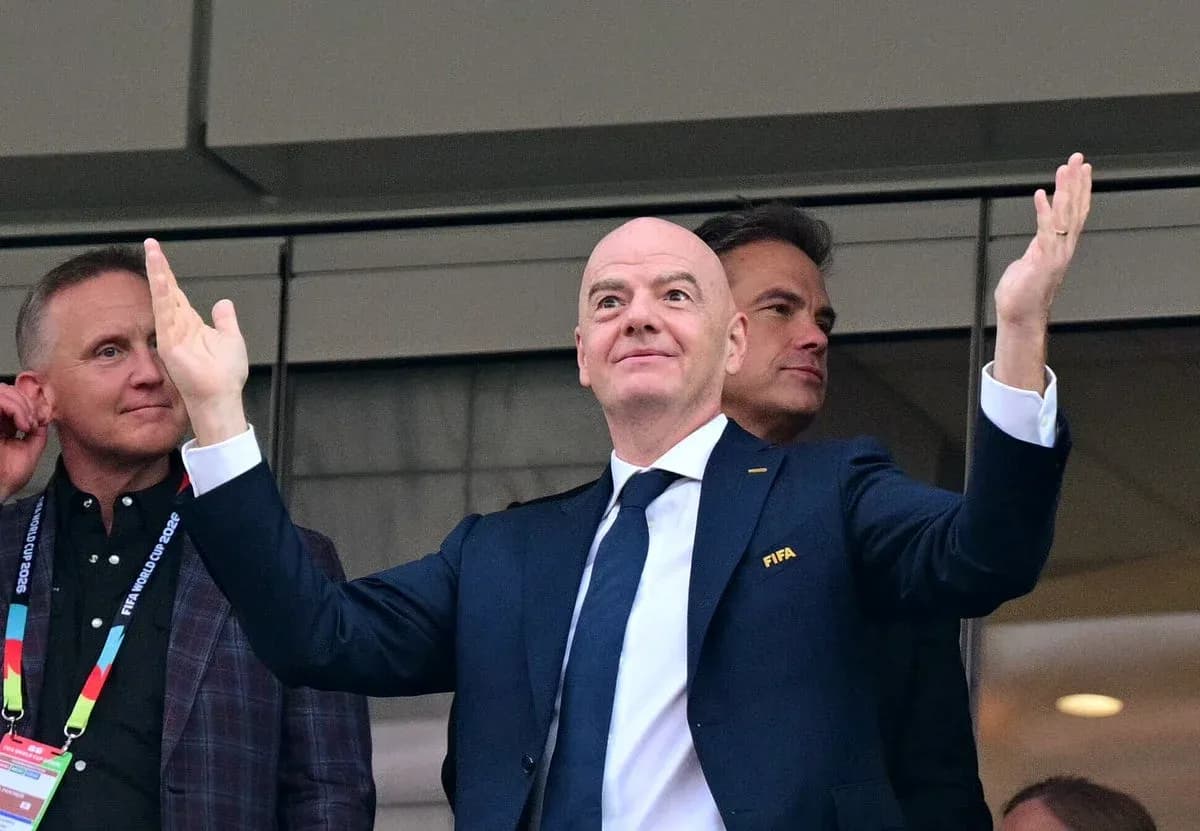
Gianni Infantino's Failed FIFA Privatization Plan
Gianni Infantino’s grand plan to part-privatise FIFA’s commercial machine is dead — and the manner of its collapse has left his presidency badly wounded.
Late on Friday night, after a week of open revolt and internal mutiny, FIFA performed a sharp and very public U-turn on the proposal to sell a minority stake in a new company, FIFA Forward Enterprises (FFE), to outside investors.
The same president who had spent days insisting “nobody is selling football” finally walked away.
A project that split the game
Infantino’s statement carried the tone of a leader forced to read the room.
“Having listened carefully to all the views,” he said, “it has become clear that the project has created divisions of a nature that, regardless of the level of support, are no longer in the interest of the objective set out in the first place.
“Our purpose has always been — and will always be — to unite and improve. As a result, this proposal will not proceed.”
The climbdown capped a furious backlash from some of the most powerful blocs in world football. UEFA, Concacaf and the Asian Football Confederation (AFC) lined up against the scheme, which would have seen FIFA create FFE to run its flagship events — including the World Cups and Club World Cups — and then sell a 21 per cent minority stake.
UEFA went furthest. It warned that all 55 of its member associations would boycott FIFA competitions, World Cups included, if the project stayed on the table. That was not a veiled threat. It was a loaded gun placed squarely on FIFA’s desk.
Concacaf and AFC then stepped forward in solidarity. Between them and UEFA, three confederations representing 137 of FIFA’s 211 member associations had now gone on record against the plan.
The numbers were turning against Infantino.
FIFA digs in – then folds
At first, FIFA tried to brazen it out.
On Friday morning in Europe, it issued a statement insisting “nobody is selling football” and stressing that it “acknowledges and respects feedback and concern aired in public” while still pressing ahead. It talked about “open and democratic consultation” and made clear it intended to keep going.
That resolve did not last long.
Soon after, AFC released its own message, aligning itself with UEFA and Concacaf. The political ground was shifting under Infantino’s feet. The prospect of him winning a vote at Congress, or even at the 37-member FIFA Council, looked increasingly remote.
Then came the blows from inside his own camp.
Carlos Cordeiro, one of Infantino’s advisers, resigned and torched the project on his way out, branding it “a bad deal for FIFA’s Member Associations, a bad deal for football, and a bad deal for the long-term future of the game.”
If that rattled the walls, Kevin Lamour shook the foundations. FIFA’s chief operating officer told The Associated Press that staff had been “deceived” by Infantino. He said he would sleep better having spoken out, even if it cost him his job.
“It is the project of one person,” Lamour said. “Not only must this project not go ahead… but the time has now come for football political leaders to ask themselves the right questions and make the right decisions.”
When your own COO is accusing you of deception in public, the battle is no longer about a business structure. It is about survival.
The money on the table
On paper, the plan was framed as a development revolution.
FIFA announced on Tuesday that FFE would run its main events and that a 21 per cent stake would be sold, aiming to raise $4.2 billion (£3.2bn). The money, FIFA argued, would be funnelled straight back to its 211 member associations through a new funding stream, the FIFA Fast-Forward Programme (FFFP).
Under the proposal, total development funding over the next four years would have exceeded $10 billion.
FIFA even tried to defuse opposition with a financial safety net. It confirmed that if the FFE project passed, every association would receive money whether or not they supported it.
Those opposed would still bank $20 million (£14.9m) each in the 2027-30 cycle, then $22 million in 2031-34 and $24 million in 2035-38, regardless of whether any stake in FFE was sold.
Those in favour would get more up front: $40 million in 2027-30, with the same increases in the following cycles.
The message was blunt: even if you hate the structure, the cheques will still arrive.
It did not work. For many, the issue was not the size of the pot, but who would sit around it.
Joshua Kushner’s venture capital firm Thrive, widely reported as the key investor, had not withdrawn by Friday night. By then, it no longer mattered. FIFA’s late statement killed the deal and rendered any investor interest irrelevant.
South America’s confederation, CONMEBOL, stopped short of outright rejection but issued a pointed reminder that financial and commercial decisions “must always serve the interests of football and never take precedence over its essence.”
Within hours, FIFA’s final statement took everything off the table.
A president exposed
The speed of the collapse has left Infantino more isolated than at any point since he replaced Sepp Blatter in February 2016.
He entered this week as the president who presided over $15 billion in revenue from the men’s World Cup this summer. Many inside the game assumed he would stroll into another term in March 2027, unopposed. Several federations had already sent letters pledging support.
By Friday night, that aura of inevitability had been shattered.
The Athletic reported that his future was openly questioned in UEFA and Concacaf meetings on Thursday. The revolt was no longer whispered in corridors; it was written into official communiqués and delivered on microphones.
Lise Klaveness, president of the Norwegian Football Federation, captured the mood in comments to VG.
“My clear impression at the moment is that he has lost a great deal of trust,” she said. “We didn’t vote for him last time, and we’ve been sceptical about this. There are many good things about FIFA, but if you take a lax approach to governance principles and rules, you quickly lose trust.”
Trust. That is the word now circling Infantino’s administration.
What began as a battle over a commercial vehicle has turned into a referendum on his leadership style, his transparency and his grip on power.
The fight to come
In the space of a few days, Infantino has gone from untouchable incumbent to a president forced into retreat by his own confederations and undermined by his own executives.
He has chosen to abandon the project to protect his position. The question is whether the damage has already been done.
The vultures are indeed circling. The calendar does not offer him much comfort. Nominations for the 2027 FIFA presidential election must be lodged by November.
For the first time in years, the race may not be a procession. It may be a contest.
Related News
Raphinha’s Hat-Trick Powers Barcelona to 7-2 Victory Over Racing Santander
Carabao Cup Fourth Round Draw: Liverpool Set to Clash with Chelsea, Arsenal to Face Fleetwood Town
Key Football Matches to Watch in Azerbaijan This Autumn
Raphinha's Hat-Trick Drives Barcelona to 7-2 Triumph Over Racing Santander
Hansi Flick Leads Barcelona to Record-Breaking Seven Wins in a Row
Gavi Reflects on Injury Return as Barcelona Dominate Racing Santander 7-2