
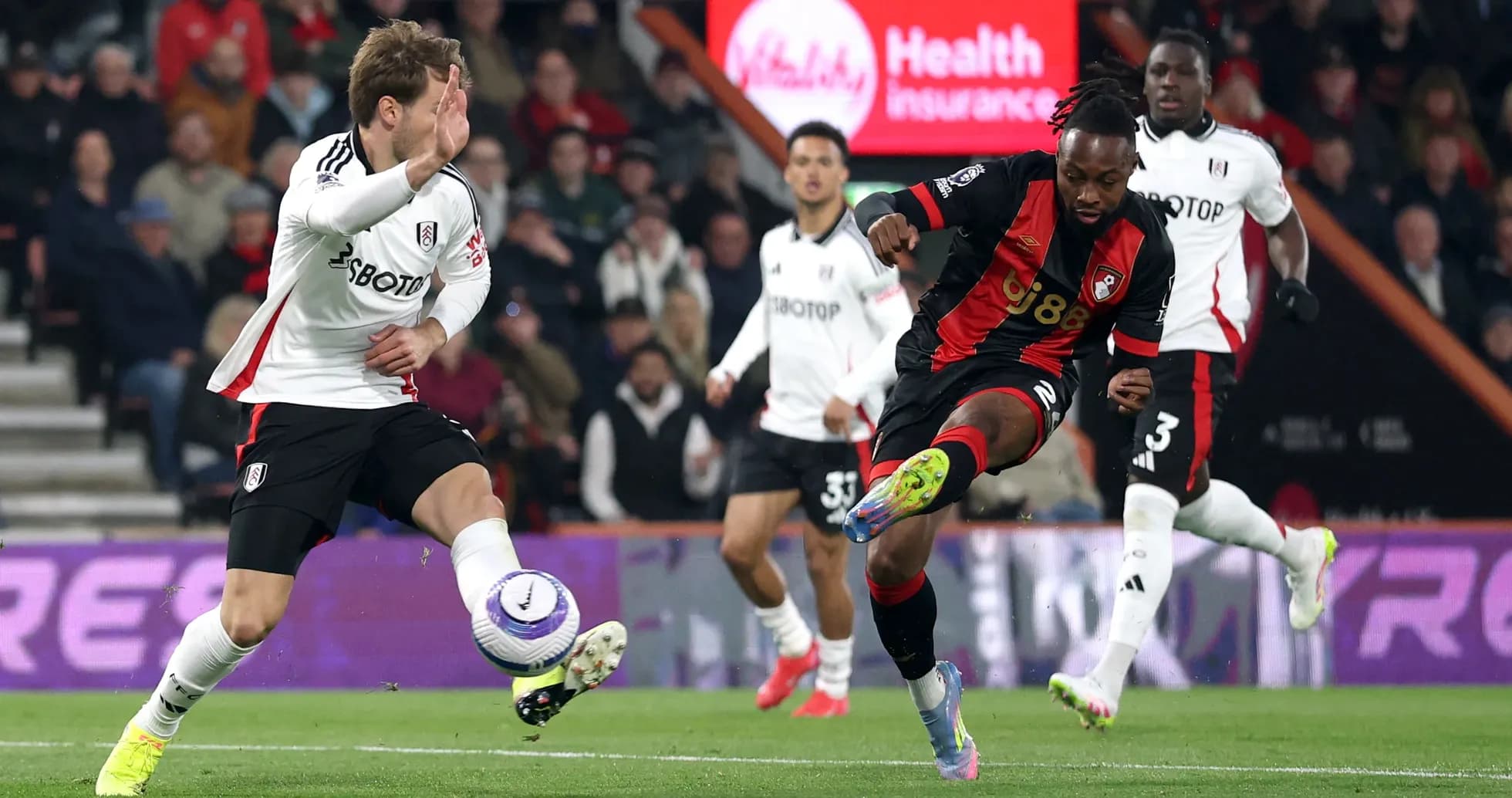
Fulham vs Bournemouth: A Narrow Away Win Highlights Seasonal Contrasts
Craven Cottage felt tight and tense as the final whistle confirmed it: Fulham 0–1 Bournemouth, a narrow away win that underlined the small margins separating mid-table security from European aspiration. Following this result in Round 36 of the Premier League season, Fulham’s campaign remains a study in home comfort and away fragility, while Bournemouth’s resilience on their travels again pushed them towards the Europa League conversation.
I. The Big Picture – contrasting seasonal identities
Fulham arrived as the league’s 11th-placed side, defined by a stark split between Craven Cottage and the road. At home they had taken 10 wins from 18, scoring 28 and conceding 20; away, they had managed only 4 wins with 16 goals for and 30 against. Overall, their goal difference of -6 was the product of 44 goals scored and 50 conceded across 36 matches, a mid-table profile built on strong London foundations and brittle away days.
Bournemouth, by contrast, came in as one of the division’s draw specialists and quiet overachievers. Sitting 6th with 55 points, they had lost just 7 of 36 league games, built on 13 wins and a striking 16 draws. Their overall goal difference of 4 (56 scored, 52 conceded) spoke of a team that rarely gets blown away, even if they occasionally flirt with chaos: on their travels they had scored 28 and conceded 33, a higher-risk version of their more controlled home game.
Heading into this game, the statistical fingerprints of both sides were clear. Fulham’s total scoring average of 1.2 goals per match, rising to 1.6 at home, rested heavily on their ability to control rhythm at Craven Cottage. Bournemouth, with a total average of 1.6 goals for both home and away, travelled with a more consistent attacking output but a looser defensive structure, conceding 1.8 goals per game on their travels.
II. Tactical Voids – absences that shaped the benches
Both coaches were forced into subtle rethinks by key absences. Marco Silva’s Fulham were without A. Iwobi and R. Sessegnon, both listed as missing through injury. Iwobi’s absence removed a flexible ball-carrier who can knit midfield to attack, placing greater creative responsibility on Tom Cairney and Emile Smith Rowe between the lines. Without Sessegnon, the left flank’s depth options narrowed, increasing the load on Antonee Robinson to provide width from full-back.
For Bournemouth, Andoni Iraola had to recalibrate his defensive and midfield balance. L. Cook, a natural organiser in front of the back four, was sidelined with a hamstring injury, while Álex Jiménez – one of the league’s most card-prone defenders with 10 yellows – was suspended. The loss of Jiménez not only removed an aggressive one‑v‑one defender but also a player who had made 69 tackles and blocked 11 shots this season, altering the profile of Bournemouth’s right side. J. Soler’s hamstring injury further trimmed Iraola’s midfield rotation, pushing more responsibility onto Alex Scott and Ryan Christie to manage transitions.
Disciplinary trends framed the risk landscape. Fulham’s yellow-card distribution showed a late-game spike: 23.29% of their yellows came between 91-105 minutes, with 21.92% in the 46-60 window and 20.55% from 76-90. Bournemouth, even more volatile late on, saw 27.71% of their yellows in the 76-90 minute band and 20.48% from 91-105, signalling a side that often defends desperately to protect results. Both teams had seen a single red card in the league, with Fulham’s lone dismissal coming in the 46-60 window and Bournemouth’s split between 31-45 and 91-105.
III. Key Matchups – Hunter vs Shield, Engine Room battles
Hunter vs Shield
In a game decided by fine margins, the attacking spotlight inevitably turned to Bournemouth’s young star Eli Junior Kroupi and Fulham’s creative spearhead Harry Wilson.
Kroupi, wearing 22 and starting from the Bournemouth midfield line here, has been one of the league’s breakout finishers: 12 total league goals from 31 appearances, with 29 shots and 20 on target. His shot profile – relatively low volume but high precision – made him the “hunter” in Iraola’s system, darting between lines and exploiting space vacated by Fulham’s advancing full-backs. Crucially, Kroupi has scored 2 penalties this season without a miss, adding composure in decisive moments.
On the other side, Fulham’s “shield” was not just the defensive unit but the structure around Joachim Andersen and Calvin Bassey. Andersen, ever-present with 33 appearances and 2884 minutes, has been a quietly elite defender: 19 blocked shots and 36 interceptions anchor Fulham’s back line. His aerial presence and reading of the game were central to containing Bournemouth’s direct entries into Evanilson and the late runs of Marcus Tavernier and Kroupi.
Engine Room – creativity vs disruption
In midfield, the duel between Harry Wilson and Bournemouth’s central triangle defined the tempo. Wilson entered this fixture as one of the Premier League’s most productive wide creators: 10 total goals and 6 assists, backed by 761 passes with 38 key passes and an 81% accuracy. He is Fulham’s primary conduit between build-up and final third, as comfortable drifting inside from the right as combining with Timothy Castagne on the overlap.
Opposing him, Ryan Christie and Alex Scott formed Bournemouth’s engine. Christie, who has 2 total league goals and a reputation for high work rate, also brings edge – he has already been sent off once this season. His 27 tackles and 4 blocks show his willingness to track runners like Wilson and Samuel Chukwueze into deep areas. Scott, more of a metronome, was tasked with finding Kroupi and Tavernier in the pockets around Saša Lukić and Cairney.
Lukić himself is a key part of Fulham’s defensive midfield screen. With 44 tackles, 9 blocks and 16 interceptions, he operates as the first barrier in front of Andersen and Bassey. But his disciplinary record – 9 yellow cards from 25 appearances – hinted at a potential pressure point if Bournemouth could repeatedly isolate him in transition.
Out wide, Antonee Robinson’s surging runs had to be balanced against the counter-threat of Tavernier and Rayan. Bournemouth’s full-backs Adam Smith and Adrien Truffert, flanking James Hill and Marcos Senesi, were charged with containing Robinson and Chukwueze while still offering support to Kroupi and Evanilson.
IV. Statistical Prognosis – why Bournemouth’s edge made sense
From a numbers perspective, Bournemouth arrived with the more stable attacking platform. Their total average of 1.6 goals per game, identical at home and away, contrasted with Fulham’s reliance on home form. On their travels, Bournemouth’s 28 goals in 18 games suggested they were well-equipped to test a Fulham defence that, overall, concedes 1.4 goals per match and 1.1 at home.
Defensively, both teams were flawed rather than fragile. Fulham’s 8 total clean sheets (5 at home) and Bournemouth’s 11 (5 away) pointed to sides capable of shutting games down when structure held. But Bournemouth’s late-card surges – 27.71% of yellows between 76-90 – also indicated that if they led, they were prepared to suffer.
Penalties offered a subtle undercurrent. Both teams had been perfect from the spot this season: Fulham scoring all 4 of their penalties, Bournemouth converting all 5. With no penalties missed by either side, any box incident carried a high probability of being decisive.
In narrative terms, Bournemouth’s narrow win at Craven Cottage felt like the logical extension of their season-long profile: a team that lives in tight games, carries a consistent attacking threat through Kroupi and company, and leans on a resilient, if occasionally frantic, defensive structure. Fulham, strong at home but overly dependent on Wilson’s creativity and the solidity of Andersen’s back line, found themselves on the wrong side of those margins – a reminder that in a league of fine details, one away goal can tilt an entire afternoon.
Related News

Bournemouth vs Liverpool Prediction: Key Stats and Betting Tips

Tottenham vs Aston Villa Predicted Lineups: Team News for Premier League Clash
Brighton vs Arsenal: Premier League Clash Preview

Manchester City vs Sunderland: Premier League Clash Preview
Tottenham vs Aston Villa: Early Relegation Battle

Brentford vs Chelsea Predicted Lineups: Team News and Match Insights