
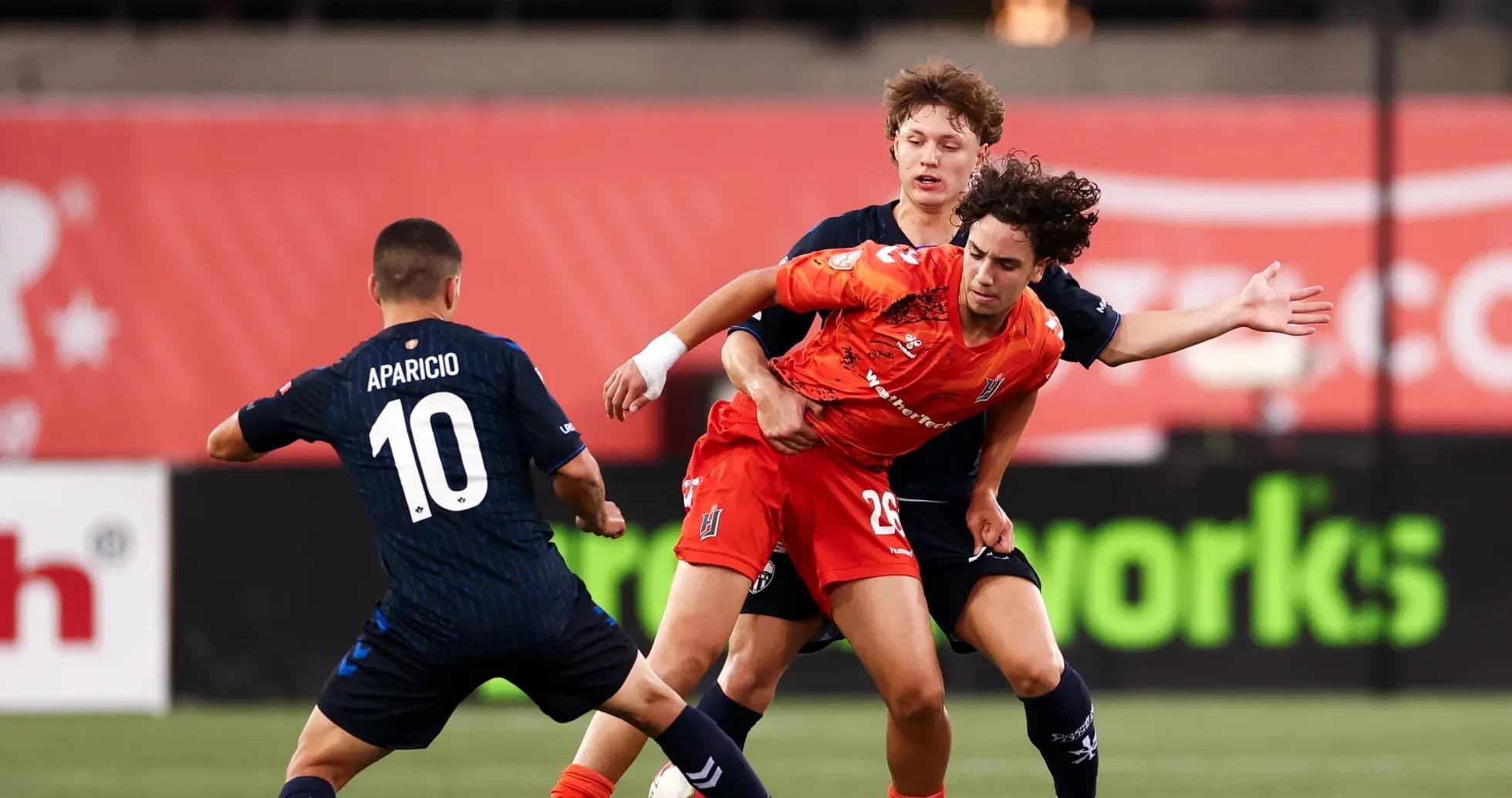
Forge Dominates Atlético Ottawa 3–0 in CPL Clash
Under the late lights at Tim Hortons Field, this Group Stage clash in the Canadian Premier League finished with a statement: Forge 3–0 Atlético Ottawa. It was not just a scoreline; it was a crystallisation of two contrasting seasonal identities. Forge, second in the table on 45 points with a goal difference of 18, played like a side accustomed to control and efficiency. Ottawa, third on 34 points but with a goal difference of -3, looked exactly like their numbers suggest: dangerous going forward overall, yet worryingly porous when stretched, especially away from home.
Over 21 matches in total, Forge have built their campaign on balance. They have scored 33 and conceded 15, and that defensive record is no accident. At home, they have allowed only 6 goals in 11 games, an average of 0.5 per match, while scoring 17 at an average of 1.5. Ottawa’s profile on their travels could hardly be more different: 13 goals for and 24 against in 11 away fixtures, conceding at an average of 2.2. This fixture became a live demonstration of those trends.
Bobby Smyrniotis set Forge up in a familiar 4-3-3, the shape that has been used most often this season. D. Bertaud anchored the back, shielded by a back four of R. Rama, D. Nimick, A. Batisse and M. Jevremović. In front of them, the midfield trio of A. Sadek, A. Aromatario and captain K. Bekker formed a layered engine room: Sadek as the link, Aromatario as the disruptor, Bekker as the tempo-setter. Ahead, a fluid front three of M. Bourgeois, B. Wright and H. Massunda stretched Ottawa’s back line horizontally, constantly asking questions of their spacing.
Ottawa’s Gustavo Leal responded with a 4-4-2 that looked designed to protect a defence that has struggled away from home. C. Kalongo started in goal, with a back four of Rony Mbomio, Loïc Cloutier, Sergei Kozlovskiy and Joaquim Coulanges. Across midfield, J. Castro and G. Antinoro worked the flanks, with M. Aparicio and D. Gutiérrez central, while the strike partnership of N. Fleuriau Chateau and Ballou Tabla promised transition threat.
Yet the tactical voids were immediately apparent. Ottawa’s defensive unit, already burdened by that away record, faced a Forge side that thrives on sustained pressure. The absence of any listed suspensions or injuries meant this was close to full-strength for both teams, but discipline was a quiet undercurrent. Forge’s season-long card profile shows a spread of yellow cards across phases, with notable spikes between 31–45 minutes and 61–75 minutes. Ottawa, by contrast, accumulate 34.69% of their yellows in the 76–90 minute window, a clear sign of late-game strain. In a match where Forge could dictate tempo, that late fragility was always likely to be exposed.
The “Hunter vs Shield” battle centred on Ottawa’s attacking stars against Forge’s defensive core. Tabla arrived as one of the league’s standout forwards, with 5 goals and 1 assist in total across 22 appearances, supported by 19 shots and 13 on target. Alongside him, Fleuriau Chateau has contributed 3 goals and 2 assists in just 9 appearances, his blend of movement and directness making him a constant reference point. Behind them, Emiliano García’s 3 goals and relentless defensive work from the front added another dimension off the bench.
Facing that trio, Forge leaned heavily on their back line and structure. Nimick, one of the league’s most complete defenders, brought 3 goals, 4 successful blocks, 10 interceptions and a 90% passing accuracy into the contest. His ability to step into midfield and break lines with the ball allowed Forge to compress the pitch, denying Ottawa the space they usually exploit in transition. Alongside him, Jevremović’s aggression and aerial dominance were tempered by a disciplinary record that already includes a red card this season, but with Bertaud protected by a unit that has kept 7 home clean sheets in total, Forge could afford to hold a relatively high line.
In the engine room, the duel between Aromatario and Aparicio defined the rhythm. Aromatario, who has committed 27 fouls and collected 8 yellow cards in total, is Forge’s enforcer, engaging in 114 duels and winning 64. His job was to disrupt Ottawa’s central progression, particularly the passing lanes Aparicio thrives in. Aparicio himself has completed 670 passes at 83% accuracy, with 11 key passes and 25 tackles in total. Yet his season also carries 6 yellow cards, a sign of how often he is forced into recovery challenges when Ottawa lose their defensive shape.
On the flanks, Antinoro’s role was twofold: carry the ball out under pressure and link with the front two. He has attempted 46 dribbles this season, succeeding 20 times, and drawn 14 fouls, but his red card earlier in the campaign hints at the fine line he walks between aggression and overreach. Against Forge’s full-backs, particularly the combative Rama, who has 5 yellow cards and a red to his name, that flank was always going to be a volatile zone.
Further up for Forge, the creative burden off the bench could fall to T. Borges and I. Oketokoun. Borges, with 3 assists and 18 key passes in total, offers a different profile to Bekker: more vertical, more willing to take risks between the lines. Oketokoun, with 2 goals and 2 assists, adds direct running and second-phase threat, ideal against a tiring back four that already concedes heavily on their travels.
Statistically, the prognosis before a ball was kicked pointed towards exactly what unfolded. Forge’s total scoring average of 1.6 goals per match, combined with Ottawa’s total concession rate of 1.7 and away concession rate of 2.2, suggested that if Smyrniotis’ side reached their usual attacking level, Ottawa would struggle to keep pace. Defensively, Forge’s total average of 0.7 goals against, underpinned by those 10 clean sheets overall, gave them a solid platform to absorb the occasional burst from Tabla or Fleuriau Chateau.
Layer on Ottawa’s penalty record – 4 awarded in total, but only 2 scored and 2 missed – and you have a side that not only leaks chances but also fails to maximise their few high-value moments. Forge, conversely, have converted all 3 of their penalties in total.
In the end, the 3–0 scoreline felt less like a surprise and more like the logical intersection of structure and fragility. Forge’s well-drilled 4-3-3, anchored by Nimick and animated by Bekker and Aromatario, suffocated Ottawa’s strengths. Ottawa’s 4-4-2, built to stabilise, instead exposed the very issues their season-long numbers have been warning about: an away defence that bends early and breaks late, and an attack that, without clinical edge from Tabla and his supporting cast, cannot compensate for the leaks behind them.
Related News

Pacific FC vs Vancouver FC Prediction: Key Stats and Betting Tips

Cavalry FC vs Forge Prediction: Key Stats and Betting Tips

Cavalry FC Dominates Pacific FC in 1-0 Clash
York United Triumphs Over Vancouver FC in Canadian Premier League Clash

Atlético Ottawa vs Supra du Quebec Stats: Head-to-Head Record

Pacific FC vs Vancouver FC Stats: Head-to-head Record