
Football's New Age of Fandom: Messi and Player Power
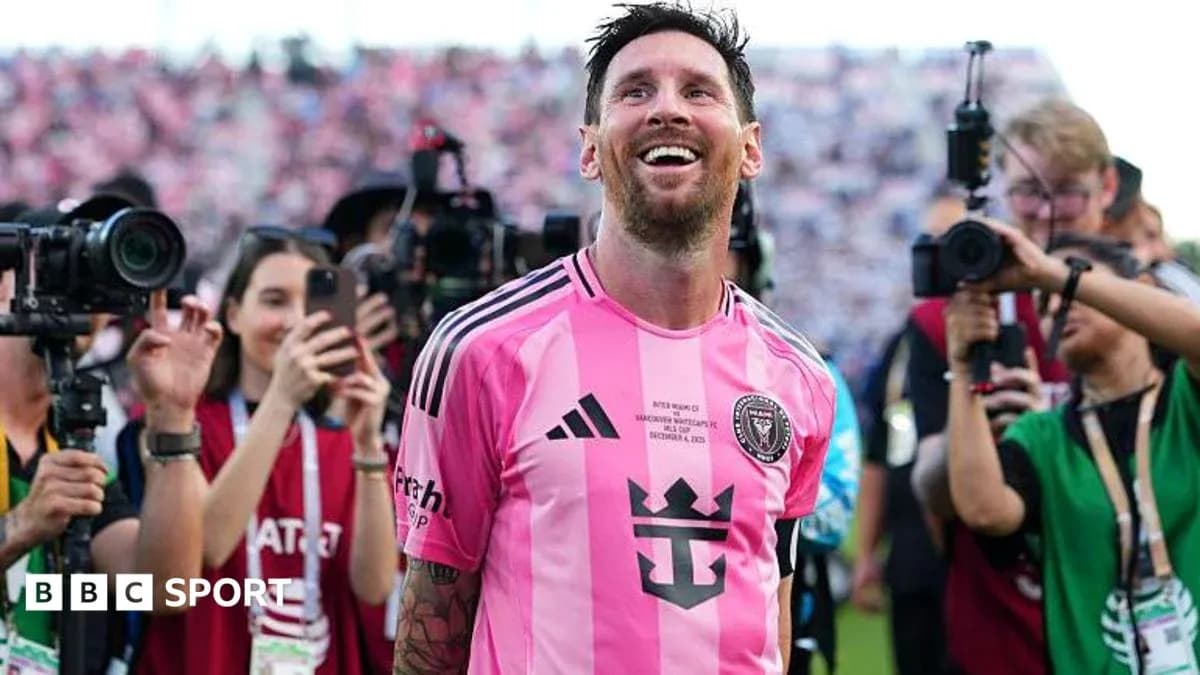
The golden ticket to football’s new age of fandom arrived in flamingo pink.
Lionel Messi’s Inter Miami shirt didn’t just launch a new chapter for MLS. It detonated across the football world. Social media numbers surged, shirts vanished from club stores, tickets rocketed to eye-watering prices. The Herons had never looked so glamorous.
But the real story wasn’t Miami. It was Messi.
“People are walking around cities and towns in the UK and Europe wearing that flamingo pink of Inter Miami with zero affiliation to Miami, having never been there,” says sports brand strategist James Kirkham. “It is the player who has done the job.”
The badge is incidental. The name on the back is everything.
From Messi in Miami pink to Cristiano Ronaldo in Al-Nassr yellow, the modern game is increasingly defined by individuals who drag entire fanbases with them. The old arguments remain – Messi or Ronaldo, Barcelona or Real Madrid, MLS or Saudi Pro League – but the battleground has shifted. The loyalty is less to the club and more to the superstar.
And it’s no longer just about those two.
From consoles to cult heroes
Kirkham has seen this coming. He traces it back to the impact of gaming on a generation raised on EA Sports FC, Football Manager and YouTube highlight reels rather than Saturday afternoons on the terrace.
Younger fans, he argues, are “less rigid or tribal than they used to be” and possess a “more encyclopaedic knowledge” of players and teams from around the globe. They jump from Atletico Madrid to Chelsea to Borussia Dortmund with the ease of a thumb on a controller.
“Fans play as these players in games,” he says. “So there is a really thin line between virtual and real life.
“Following a player and buying them as part of your Ultimate Team and then wearing that player's name on the back of your shirt, be that Atletico Madrid or Chelsea or Dortmund, kind of makes no difference.”
The old line, paraphrasing Eric Cantona, was that you could change almost anything in life but never your football team. Geography and family handed you your club and that was that.
Not anymore.
A study titled ‘The Rise of the Second Club Fan’, published before this summer’s World Cup, found that 80% of global supporters now also follow a second team. Matthew Kyle, head of insights at Engage and MTM and the report’s author, says this isn’t about abandoning a boyhood side. It’s about adding another – or several – to the mix.
In parts of the world where domestic leagues lack global clout, that second club often comes from overseas. Geography is no barrier. Story is.
“They are often looking for ‘who else can I support?’ It’s more natural,” Kyle explains.
Some latch onto a club’s history or values. Others like a kit. But the study is clear: the most powerful gateway is a player. When that player moves, a chunk of the support moves with them.
“For this audience, they are the club,” the report concludes. “These fans track individuals, not institutions.”
Griezmann’s misfire, Haaland’s moment
Football hasn’t fully adjusted to this yet. But players have started to sense their power.
Back in 2018, Antoine Griezmann tried to seize control of his own story. Days before France began their World Cup-winning campaign, he teased ‘The Decision’ – a half-hour Spanish TV documentary that would reveal whether he was leaving Atletico Madrid for Barcelona.
Gerard Pique, whose company produced the show, lobbed petrol on the fire with a popcorn emoji on social media. Barcelona were confident. Most viewers were too.
Then came the twist. Standing outside the Metropolitano, Griezmann announced he was staying put. Two endings had reportedly been filmed to keep the secret. He picked loyalty. The reaction was not what he expected.
The self-confessed NBA fanatic had borrowed the format from LeBron James’ famous 2010 special when he joined the Miami Heat. But where LeBron’s ‘The Decision’ became a landmark in player power and branding, Griezmann’s version drew criticism and ridicule.
Kyle believes the timing was off. “Self-commercialisation” on that scale, he says, would land very differently now if it came from Erling Haaland or Kylian Mbappe.
Griezmann, in many ways, was ahead of his time. Today, the biggest names barely need TV. They run their own channels. Haaland, Ronaldo, Jude Bellingham, Ella Toone – they broadcast directly to millions on YouTube, TikTok and Instagram, curating their own image, controlling their own narrative.
“Players are becoming their own distribution levers,” says Kyle, “with some in particular taking a driving seat in terms of ‘how I project myself onto the world’ and building their own channels and audience.”
Fans don’t just watch them play. They follow their journeys. They see their homes, their holidays, their routines. The distance between star and supporter shrinks.
More than a shirt, more than a game
With that access comes expectation. Players are no longer just athletes or endorsers. They are cultural symbols.
“Players are far more culturally symbolic than they used to be,” says Kirkham. “It is not that players don't do endorsements now, but they know they have to resonate with fans, so fans can really latch on to them and get behind them.
“Look at what Marcus Rashford did during Covid in terms of changing actual legislation.
“Young fans want to know players stand for something more – that gives them more chance to follow and pursue them, find a deeper connection with them.
“They look for stuff that is aligned to them, who they are, their causes and where they're from. I think we will increasingly see that.”
This summer’s World Cup, staged in North America, became a global shop window not just for teams, but for individual brands.
Vozinha, Cape Verde’s 40-year-old goalkeeper, turned into a cult figure almost overnight after his heroics against Spain. His Instagram following exploded from around 50,000 to nearly 30 million.
The established stars cashed in as well. Lamine Yamal’s numbers soared. Bellingham’s did too. Even Ronaldo, already the most-followed athlete on Instagram, added significantly to his tally.
The biggest winner, though, was Erling Haaland.
Norway’s forward saw his popularity rocket as fans poured onto his Instagram, TikTok and Snapchat accounts. The appeal? A mix of humility and meme-ready charisma. One day he’s in a cowboy hat, the next he’s helping Norway’s kit man. He replies to posts, leans into viral clips, and plays up his “bromance” with former team-mate Bellingham. A Russian model who looks uncannily like him only fed the online frenzy.
“Haaland was a massive winner from the World Cup,” says Kyle. “He gained more than 51 million followers since 1 July on his social accounts – bear in mind the first six months of this year he only gained 11 million.
“Obviously he had a good World Cup. But a massive part of it was the personality coming across, interacting with fans, memes, his stature and what he looks like, Norway being there [in the last eight] for the first time and the fans’ rowing celebration – all that kind of stuff.”
Haaland didn’t just score goals. He built a relationship.
When the hero moves on
All of this leaves clubs with a nagging question: what happens when the player who brought millions of new eyes to your badge walks away?
That’s where the idea of the national hero kicks in.
Trabzonspor are currently feeling the uplift after signing Egypt star Mohamed Salah following his glittering nine-year spell at Liverpool. Tottenham had a similar experience with Son Heung-min. He arrived in north London as a major name in South Korea but not yet a global icon. Over a decade, he became one – and Spurs, as Kyle points out, “became the most-supported foreign club there, topping Manchester United”.
Then Son left for LAFC last summer.
Did Spurs’ Korean following vanish overnight? No. “When Son left, Spurs didn't immediately lose millions of followers on their socials from Korea,” Kyle explains. “But we did see a small spike on his new club.”
Some fans stay with the club. Others follow the player. Many do both.
For clubs, the challenge is clear: keep those new supporters engaged even after their original hero has gone.
“It is about trying to deliver content those fans still want to engage with,” Kyle says. “The easy answer is to say global superstars will do it on their own and these clubs without them will struggle. But every club has characters.
“Every player leaves eventually, even if they leave by retiring at your club. So it's about using them as an asset while there and thinking about how all fans are also interested in stuff off the pitch.
“Behind the scenes content always does really well. Even if you're not a fan of that club, you might stop scrolling and watch ‘a day in the life’ of a player because it might be good content.”
Clubs that understand this treat the dressing room like a cast list. The season becomes a series. The access is the hook.
Think of Welcome to Wrexham. A non-league club turned into a global curiosity not just by results, but by storytelling – and by its owners.
From superstar to super-owner
Which raises another twist in this new landscape: what if the star isn’t on the pitch at all?
“Ryan Reynolds and Rob Mac would have been a huge draw for people who don't know football,” Kyle notes. “On the counter, there will be people in the football community saying ‘this will be interesting because what the hell do they know?’”
Both audiences tuned in. One for Hollywood. One for the chaos. Both stayed for the drama.
That is the modern game. Football as soap opera. Seasons of television, seasons of football, different stories, rolling endlessly into one another. Messi in Miami pink. Ronaldo in Saudi gold. Haaland dancing in a cowboy hat. A goalkeeper from Cape Verde becoming an overnight icon.
The clubs are still there, with their crests and their histories and their songs. But the gravitational pull has shifted. Fans now orbit players, narratives, personalities – and sometimes even owners.
In a sport that never stops, the real question is simple: who will they follow next?
Related News
Transfer Rumors: Haaland’s Two Options; Real Madrid Targets $100 Million Premier League Star
Manchester United Targets Premier League Forward to Strengthen Attack
Liverpool Eyes 17-Year-Old Mexican Midfielder Gilberto Mora for Summer Transfer
Summer 2026 Transfer Window: Manchester United and Tottenham Struggle with New Signings
Liverpool Maintain Interest in Real Madrid Midfielder Amid Transfer Challenges
Transfer Insider Warns Tottenham About Costly Sale of Will Lankshear