
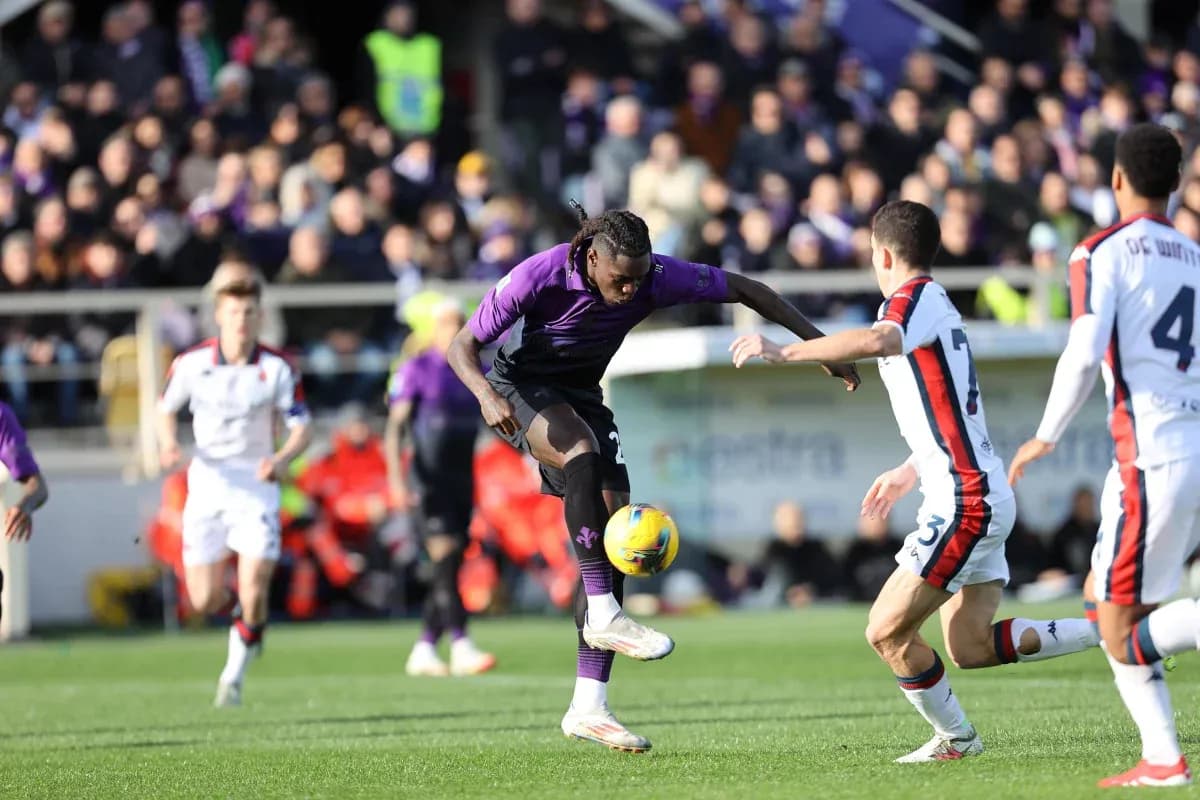
Fiorentina and Genoa Share Points in Stalemate
Stadio Artemio Franchi felt strangely suspended in time for this one. A sun‑splashed afternoon, round 36 of Serie A, two sides locked in mid‑table, and yet the 0‑0 that followed between Fiorentina and Genoa said plenty about who they are this season – and where they might be heading.
I. The Big Picture – A Stalemate That Fits the Season
Following this result, the table snapshot still captures two teams living in the same neighbourhood. Genoa sit 14th on 41 points, Fiorentina 15th on 38, their campaigns defined less by collapse than by a kind of stubborn inertia. Overall this season Fiorentina have won 8, drawn 14 and lost 14 from 36 matches, scoring 38 and conceding 49. The goal difference of -11 underlines a side that leaks just enough to undermine its attacking intentions.
Genoa’s profile is marginally sharper: 10 wins, 11 draws and 15 defeats, with 40 goals for and 48 against, a goal difference of -8. On their travels they have been awkward rather than adventurous – 4 away wins, 7 draws, 7 defeats, 19 scored and 24 conceded – a compact, counter‑punching outfit that came to Florence to control the rhythm rather than chase chaos.
The goalless draw therefore felt like the logical intersection of two statistical DNAs: Fiorentina at home averaging 1.1 goals scored and 1.1 conceded, Genoa away sitting on 1.1 scored and 1.3 conceded. Two teams who tend to live on fine margins produced exactly that.
II. Tactical Voids – What Was Missing
The team sheets told their own story of absences. Fiorentina were without their leading scorer M. Kean, ruled out with a calf injury. His 8 league goals and 2 penalties scored have been the sharpest edge in a side that has failed to score in 11 matches overall. Removing that reference point forced Paolo Vanoli to improvise: F. Parisi, R. Braschi and M. Solomon formed a fluid front three, more about interchange and movement than penalty‑box presence.
Behind them, N. Fagioli and C. Ndour flanked R. Mandragora in a 4‑3‑3 that tried to build patiently through the thirds. The problem was obvious: without Kean’s ability to attack crosses and run channels, Fiorentina’s possession often died on the edge of Genoa’s back line.
Genoa had their own voids. T. Baldanzi, Junior Messias, B. Norton‑Cuffy and M. Cornet were all unavailable, stripping Daniele De Rossi of some of his most inventive and vertical options between the lines. That absence of natural creators pushed Genoa towards a more functional 3‑4‑2‑1: Vitinha as the nominal spearhead, with J. Ekhator and L. Colombo offering runs rather than refined link play.
Disciplinary trends also shaped the tone. Heading into this game, Fiorentina’s yellow card distribution showed a pronounced late‑game spike: 25.00% of their bookings arriving between 76‑90 minutes, and both of their red cards this season also in that window. Genoa, by contrast, tend to flare earlier and in phases – 24.59% of their yellows from 61‑75 minutes, and red cards scattered across 0‑15, 46‑60 and 91‑105. That backdrop encouraged both coaches to keep the tempo controlled, wary that a frantic final quarter could tilt the contest on a single rash tackle.
III. Key Matchups – Hunter vs Shield, Engine Room vs Enforcer
Without Kean on the pitch, Fiorentina’s “Hunter” became more collective than individual, but the spine still revolved around three figures.
At the back, M. Pongračić anchored the line. Across the season he has been a defensive metronome: 1855 passes at 91% accuracy, 30 tackles, and notably 23 blocked shots – a defender who does not just hold position but actively attacks danger. His 11 yellow cards, the highest tally in the league’s disciplinary charts, underline the edge he brings; he plays on the line, and sometimes over it, to protect a team that concedes 1.4 goals per game overall.
His duel with Genoa’s front three was more about prevention than recovery. Vitinha, Ekhator and Colombo looked to pull him into wide areas, but Fiorentina’s back four, completed by Dodo, L. Ranieri and R. Gosens, held a disciplined line. Ranieri, himself on 8 yellow cards this season, balanced aggression with timing, adding 34 tackles and 11 blocked shots to the defensive ledger. Together, they suffocated Genoa’s attempts to turn territory into clear chances.
On the other side of the ball, Genoa’s “Shield” had a name and a number: Aarón Martín. The left‑sided defender, one of the league’s top assist providers with 5, is as much a playmaker as a full‑back. His 714 passes with 60 key passes show how often Genoa’s attacks flow through his channel. Defensively, 41 tackles and 11 blocked shots highlight his work without the ball.
In Florence, his lane was a battleground. Martín had to contain M. Solomon’s dribbling and the underlaps of Parisi, while still offering width going forward. Fiorentina’s inability to overload him consistently – without Kean pinning the central defenders – allowed him to stay compact, rarely exposed in pure 1v1 isolation.
The “Engine Room” duel ran through R. Mandragora against Genoa’s central pair of Amorim and M. Frendrup. Mandragora’s task was to break Genoa’s 3‑4‑2‑1 block with vertical passes into Braschi and Solomon. Amorim and Frendrup, though, screened intelligently, forcing Fiorentina into sideways circulation. With Genoa comfortable defending their box – they have kept 5 clean sheets away from home this season – the visitors were happy to let Fiorentina have sterile possession.
IV. Statistical Prognosis – xG Shapes a Drawn Future
Even without explicit xG numbers, the season data sketches the likely expected‑goals landscape of this match. Fiorentina at home, scoring 20 and conceding 20 in 18 games, are a team whose home xG for and against are typically balanced around 1.1 in each direction. Genoa away, with 19 scored and 24 conceded from 18, project an away profile of roughly 1.1 xG for and 1.3 xG against.
Overlay those curves with the absences of Kean and Baldanzi and the defensive strengths on show – Pongračić’s penalty‑box command, Aarón Martín’s dual‑role security, and Genoa’s 9 clean sheets overall – and a low‑scoring outcome was always the rational prediction. Two sides who each have failed to score in double‑digit matches (Fiorentina 11, Genoa 14) simply reproduced their season‑long inefficiencies in the final third.
Following this result, nothing fundamental changes in their trajectories. Fiorentina remain a possession‑leaning side whose structure often outstrips their penalty‑area punch; Genoa continue as a compact, system‑driven unit that relies on collective discipline and set patterns rather than individual brilliance.
If there was an xG verdict, it would read something like this: marginal Fiorentina edge on volume, Genoa parity on chance quality, the draw a fair reflection. In a campaign defined by fine margins and mid‑table gravity, this 0‑0 felt less like a missed opportunity and more like a mirror – each team seeing its season, with all its limitations, staring back from across the halfway line.
Related News
Frosinone vs Como Prediction: Key Stats and Betting Tips

Fiorentina vs Napoli Prediction: Key Stats and Betting Tips

AS Roma vs Inter: Serie A Showdown on 19 September 2026

Inter’s Dominance in 5–3 Win Over Udinese

AS Roma vs Inter Prediction: Key Stats and Betting Tips
Lazio and AC Milan Battle to a 2–2 Draw: Early Serie A Insights