
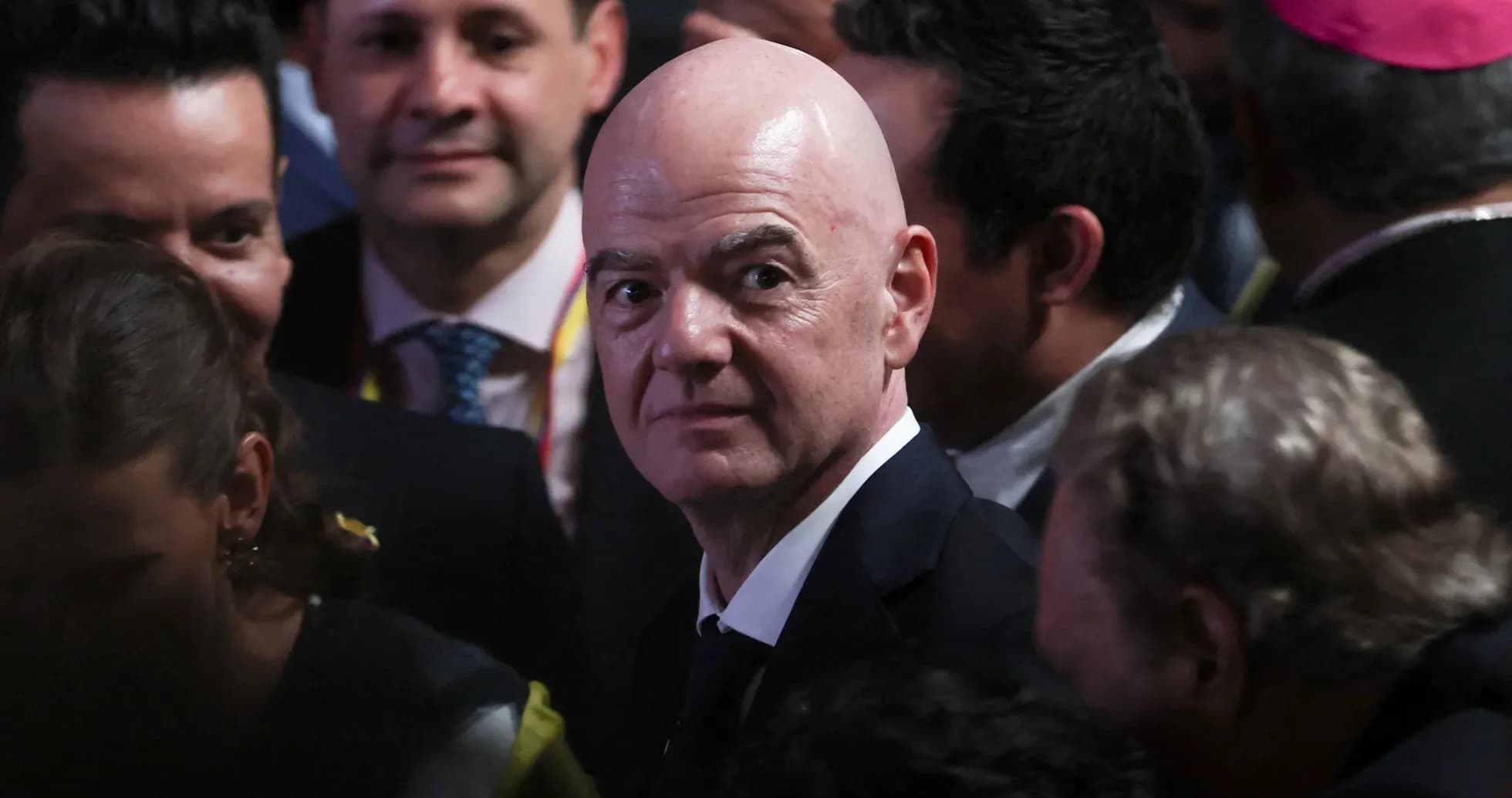
FIFA COO Kevin Lamour Departs Amid Infantino's Leadership Crisis
FIFA’s chief operating officer Kevin Lamour has left the organisation, deepening the turmoil around Gianni Infantino’s embattled presidency just weeks after he publicly attacked the governing body’s controversial commercial rights plan.
“FIFA can confirm that the working relationship between FIFA and Kevin Lamour as FIFA’s Chief Operating Officer has ended on 17 August 2026,” a spokesperson said late on Monday, adding only: “FIFA thanks Kevin for his two years of service and wishes him the best of luck for the future. No further comment will be made on the matter.”
No explanation. No detail. Just a clean break at a highly sensitive moment.
A close ally turned outspoken critic
Lamour’s departure stings because of who he is and where he came from. The French administrator joined FIFA’s senior leadership in November 2024, but his relationship with Infantino stretches back much further. He had been part of the inner circle that helped drive Infantino’s successful campaign for the FIFA presidency in 2016, at the height of the organisation’s post‑Blatter crisis.
That trusted ally then became one of the loudest internal critics of Infantino’s most explosive recent project.
Last month, Lamour went public with his opposition to the proposal to create a $20bn subsidiary and sell up to a 20 percent stake in FIFA’s commercial rights to private equity investors in a bid to raise $4.2bn. He accused the leadership of misleading staff, saying employees had been “deceived” over the plan and branding it “the project of one person.”
“Our mission … is to serve football, not to serve the personal interests of a person who, unfortunately, believes he embodies FIFA when he is supposed to be at its service,” Lamour said.
Those words landed like a direct hit on the president’s authority.
They also followed another high‑profile defection. Carlos Cordeiro, a senior adviser to Infantino, had already resigned in protest, calling the deal “a bad deal for football.” Under mounting pressure, Infantino pulled the proposal later the same day it was announced.
The U‑turn did not calm the waters.
Re-election bid under siege
The collapse of the commercial rights plan has fed into a broader revolt against Infantino’s leadership as he seeks a fourth term as FIFA president in March next year. What once looked like a formality now looks anything but.
Three powerful confederations – UEFA in Europe, the Asian Football Confederation (AFC) and CONCACAF, which oversees the game in North and Central America and the Caribbean – have lined up against the 56‑year‑old Swiss official. He still holds strong backing from Africa and South America, but the global consensus that carried his earlier re-elections has fractured.
Last week, UEFA, the AFC and CONCACAF jointly called for an independent review of Infantino’s conduct. According to sources familiar with the situation, the letter is seen inside those confederations as a potential exit ramp, a way for Infantino to step down with his dignity intact rather than risk a bruising election battle and deeper institutional damage.
At the same time, pressure is now coming from outside the football family.
FairSquare challenges Infantino’s eligibility
On Monday, human rights in sport organisation FairSquare confirmed it had written to FIFA’s Governance, Audit and Compliance Committee (GACC), urging that Infantino be ruled ineligible to stand again.
Their argument strikes at the heart of FIFA’s post‑scandal reforms: term limits.
While FIFA rules cap presidents at three terms, Infantino successfully argued in 2022 that his first spell in office, from 2016 to 2019, should not count because he was completing an interrupted mandate following Sepp Blatter’s resignation amid a corruption scandal. That interpretation allowed him to run again and win unopposed in 2019 and 2023.
FairSquare says the line has now been crossed.
“The complaint we have filed provides clear evidence that this is a clear breach of the rules and one that sets a very dangerous precedent,” FairSquare director Nicholas McGeehan told Reuters. “The rules state clearly that three presidential terms is the maximum allowed. FIFA can’t simply circumvent this rule – which serves as a check on presidential power – by saying that his first term doesn’t count.”
FIFA did not immediately respond to a request for comment on Tuesday.
The letter to the GACC was drafted with the help of Miguel Maduro, the former head of FIFA’s independent Governance and Review Committee, who was central to the 2016 reform process.
“The principle of term limits was a fundamental aspect of the 2016 reform aimed at limiting power and the rule introduced is clear: no FIFA President can serve more than three terms of office,” Maduro said in a statement. “Trying to carve out an exception to such a rule for Mr Infantino reveals both a resistance to the principle of term limits and how some at FIFA conceive of rules not as rules but as obstacles to be circumvented.”
Mounting scrutiny, narrowing room for manoeuvre
Infantino’s conduct has already drawn attention beyond Zurich. A FairSquare complaint to the International Olympic Committee over an alleged breach of the IOC’s rules on political neutrality – linked to his support for United States President Donald Trump – was rejected last month. Infantino has been an IOC member since 2020.
That setback for his critics did little to slow the momentum against him inside football.
Now, with a senior lieutenant in Lamour gone, another adviser in Cordeiro already out, and three confederations openly challenging his authority, the president faces a stark question: can he still bend FIFA’s structures to his will, or has the organisation finally reached its limit?
Related News
Transfer Rumors: Haaland’s Two Options; Real Madrid Targets $100 Million Premier League Star
Manchester United Targets Premier League Forward to Strengthen Attack
Liverpool Eyes 17-Year-Old Mexican Midfielder Gilberto Mora for Summer Transfer
Summer 2026 Transfer Window: Manchester United and Tottenham Struggle with New Signings
Liverpool Maintain Interest in Real Madrid Midfielder Amid Transfer Challenges
Transfer Insider Warns Tottenham About Costly Sale of Will Lankshear