
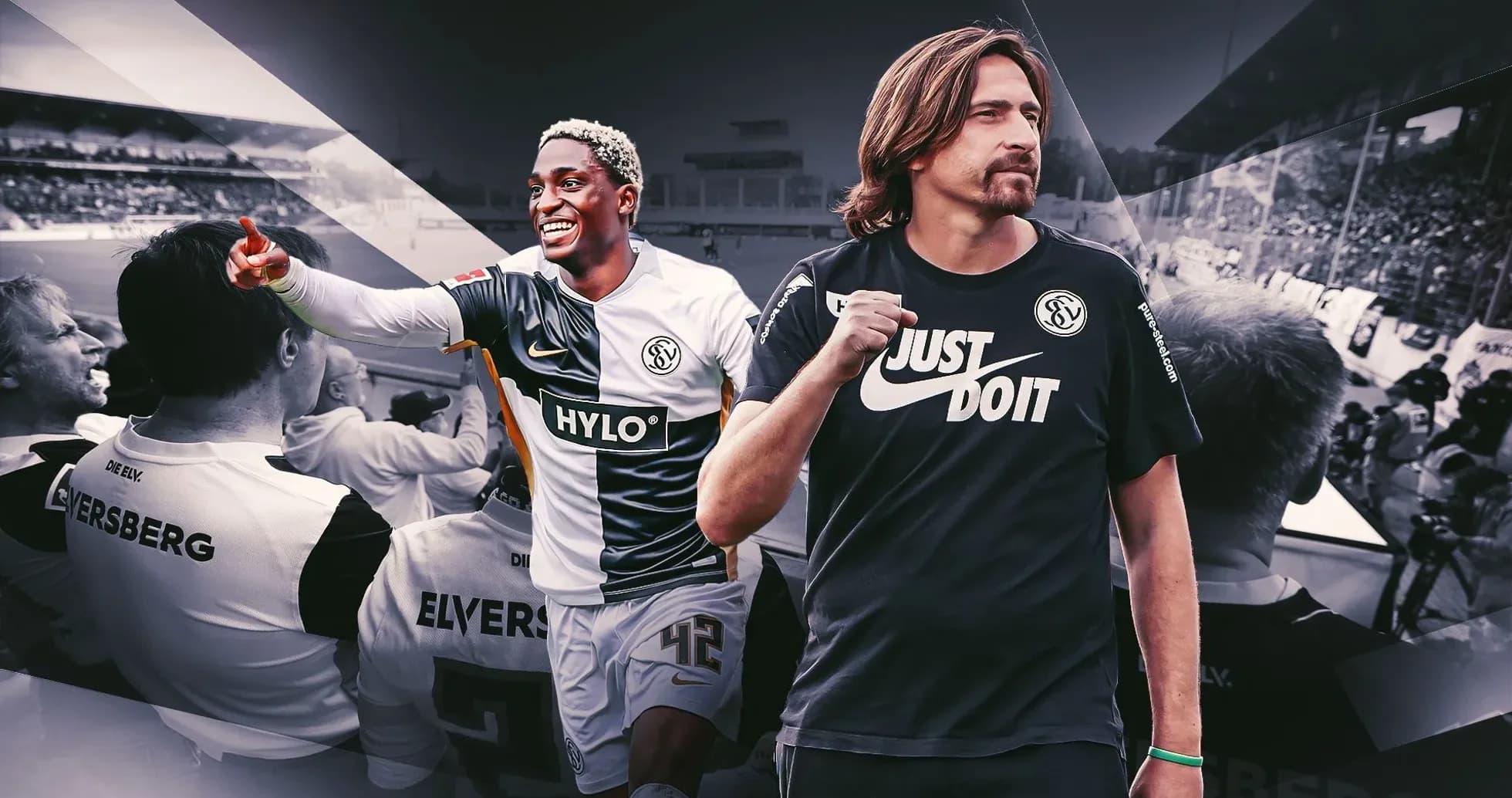
Elversberg: From Village Club to Bundesliga Sensation
In Elversberg, they like to joke that the bus to the stadium is more regular than the train service. There is no station. No grand town hall. Just 13,000 people in a corner of the Saarland and a football club that has somehow muscled its way into the Bundesliga.
Germany has never seen a top-flight club from a smaller place. The nickname writes itself: Dorfverein. The village club.
From village pitch to professional dream
Elversberg first appeared on the football map in 1907, disappeared during the First World War, and came back in 1918. For decades, they were what their surroundings suggested they should be: a modest amateur side, tucked away in regional leagues, far from the spotlight.
The turning point came in the early 2000s. Local pharmaceutical company Ursapharm stepped in as main backer and sponsor, guided by then-president Frank Holzer and later his son Dominik, who took over in 2011. Money alone didn’t turn Elversberg into a force, but it did give them a platform.
In 2013, they climbed into the 3. Liga for the first time. They were immediately relegated, yet something had shifted. Ursapharm bought the naming rights to the stadium, now the Ursapharm-Arena an der Kaiserlinde, a nod to the old lime tree that had watched over the ground for a century before falling in 2015. Capacity crept up towards 10,000. Infrastructure grew. Ambition followed.
What they still lacked was a footballing identity. That arrived in 2018, with Horst Steffen.
Steffen’s revolution
Steffen walked in and ripped up the script. Elversberg would not be the plucky, reactive underdog. They would attack. They would entertain. They would take risks.
The Regionalliga Südwest title in 2021-22 was the first major reward for that philosophy, earning promotion back to the 3. Liga. This time, they were ready.
They announced it in style. In the opening round of the 2022-23 DFB-Pokal, Elversberg stunned Leverkusen 4-3, the biggest scalp in their history. Bochum ended the cup run in the next round, but the tone was set. In the league, Steffen’s side sustained that level.
They edged Freiburg to the 3. Liga title after a fierce promotion race that saw the top five separated by just five points. No team scored more: 80 goals in 38 games, 10 of them from Stuttgart loanee Nick Woltemade. Steffen once said he preferred a spectacular win to a “measly 1-0”. His players lived that motto every week.
The step up to the 2. Bundesliga brought a reality check, yet Elversberg still finished a highly respectable 11th in their debut season. Then came 2024-25, and a run that took them within touching distance of the “Promised Land”.
They finished third behind Köln and Hamburg, booking a promotion/relegation play-off against Heidenheim. A 2-2 draw in the first leg kept the dream alive. The second leg was locked at 1-1 deep into stoppage time. Then, in the fifth added minute, Leo Scienza struck and shattered Elversberg’s hopes.
The heartbreak doubled when Steffen left for Werder Bremen soon after. The club banked €300,000 in compensation, a tidy sum by their standards, but it barely softened the loss of the coach who had dragged them to unprecedented heights.
Enter Wagner
Finding the right successor became a painstaking process. Sporting director Nils-Ole Book wanted more than a safe pair of hands. He wanted a coach who understood modern tactics, who would keep the football bold and intense, and who would trust youth.
They landed on Vincent Wagner, fresh from leading Hoffenheim’s reserves to promotion to the 3. Liga in 2024-25.
“With everything he brings to the table, he fits in very well with us,” Book said at Wagner’s unveiling. “Vincent will not only continue our current path, but also enrich and develop it with new energy.”
On paper, Wagner looked a gamble: inexperienced at the top level, taking over a club that had just lost its visionary coach. The mood dipped further when the loan deals of key scorers Fisnik Asllani and Muhammed Damar expired, and defensive leader Robin Fellhauer left for Augsburg. Pundits circled “mid-table” as Elversberg’s new reality.
Book refused to accept that. With limited funds, he pieced together a new core. Lukasz Poreba, Bambase Conté and Jarzinho Malanga arrived on loan from Bundesliga clubs. Lasse Günther and Jan Gyamerah came in permanently to reinforce the back line.
The pieces clicked quickly. Wagner’s first full season, 2025-26, turned into a landmark campaign.
Elversberg tore out of the blocks, winning seven of their first nine league games. The form wobbled at times, but they never fell away. Schalke eventually pulled clear to secure the title, yet the race for second, the final automatic promotion place, went to the wire.
On the final day, Elversberg sat second, ahead of Paderborn on goal difference, with rock-bottom Preußen Münster visiting the Ursapharm-Arena. The pressure could have suffocated them.
It didn’t. Wagner’s side produced a ruthless 3-0 win, sealing promotion and writing a new chapter: Elversberg, a Bundesliga club, 119 years after they were born.
“Of course, this is something special,” Wagner said. “A friend of mine said this week, ‘If Elv can get promoted, it’s like flying to the moon.’ And we managed to make the moon landing today.”
Selling the top scorer, still going up
The story grows even more improbable when you consider what happened in January. Elversberg sold the league’s top scorer, Younes Ebnoutalib, to Eintracht Frankfurt. Two months later, Book left for Borussia Dortmund.
Most clubs would have collapsed under that double blow. Elversberg didn’t.
Lukas Petkov stepped forward, scoring six times in the second half of the season and finishing with 11 assists across the campaign. Tom Zimmerschied became the ideal foil, contributing nine goals and assists of his own. The attack remained ferocious: 64 league goals, the best record in the division. At the other end, they conceded just 39, second only to Schalke.
The Dorfverein had become a machine.
Building for the Bundesliga
Promotion triggered sweeping changes. The Ursapharm-Arena needed an upgrade to meet Bundesliga standards, so the diggers rolled in. By next spring, capacity will rise to 15,000. For now, one side of the ground looks more like a construction site than a top-flight arena, with a temporary steel gantry serving as the press area.
There was change off the pitch, too. Christian Weber arrived from Fortuna Düsseldorf, where he had spent 16 years as a scout and then sporting director. Stepping into Book’s shoes was no small task, given his knack for uncovering hidden gems, but Weber moved smartly in his first window.
He snapped up 21-year-old attacking midfielder Maurice Krattenmacher from Bayern for just €2m. He leaned again on the loan market, bringing in Francis Onyeka from Bayer Leverkusen, Noah Darvich from Stuttgart and Noel Futkeu from Eintracht. The headline move, though, was a club-record €6m deal for Cole Campbell from Dortmund.
Campbell, one of the United States’ brightest prospects, arrived with serious expectation. New technical director Josef Welzmüller did little to dampen it.
“He’s a fantastic player. He’s very fast and strong with the ball and in one-on-one situations,” Welzmüller told Bulinews in August. “We are very, very sure that he will have a breakout season.”
Just as striking was what Welzmüller said about the team’s style. There would be no tactical retreat, no deep block to simply hang on in the Bundesliga. Wagner, fond of his space analogies, calls survival a “mission to Mars”. The club’s answer? Stay brave.
“We won’t do anything different,” Welzmüller told BBC Sport. “The identity stays the same and it is built on three core pillars. The first is to be brave, the second is to be intense and the third is to be clever.”
Those pillars looked rock solid on the opening weekend.
Leverkusen stunned, Elversberg arrive
Carles Martínez’s Leverkusen walked into the Ursapharm-Arena expecting to impose themselves on the newcomers. They were ambushed instead.
Within 10 minutes, Elversberg led 2-0. Petkov struck first with a deflected effort. Then Campbell announced himself. He pounced on a loose pass, drove at the defence with purpose and unleashed a ferocious shot that Mark Flekken couldn’t keep out. A 20-year-old with only 10 previous Bundesliga appearances, suddenly dictating the tempo in a feverish, half-finished stadium.
Right after the interval, Elversberg hit again. Just 25 seconds into the second half, David Mokwa arrived to turn in a low Petkov cross from close range. 3-0. The champions-elect had become the ones hanging on.
Leverkusen did respond. Patrick Schick and Christian Kofane pulled goals back, but the damage was done. Wagner had started seven Bundesliga debutants; Campbell, with those 10 games, was the most experienced top-flight player in the squad. It didn’t matter. Elversberg overpowered a side built for the Champions League.
“We fortunately did this with our fans behind us. We’re small but mighty,” Wagner said afterwards. “We’ll have to continue to play courageous football as it’s the only way we’re going to have a chance in this league.”
Gladbach thriller shows Elversberg’s steel
If Leverkusen felt like a statement, what followed at ista-Borussia-Park on matchday two showed the soul of this team.
Away to Gladbach, Elversberg fell 3-1 behind before the hour mark. Frustration boiled over when the referee awarded a throw-in the wrong way in the build-up to the hosts’ second goal. Wagner protested and saw red.
From the stands, he still managed to shape the game. His substitutions changed everything.
Krattenmacher, thrown on, needed just a minute to make his mark. He met a cross with a header that crashed against the bar, then reacted quickest to slide in the rebound. 3-2, belief restored.
The equaliser was a moment of pure technique. In the 80th minute, Felix Heidel stepped up and whipped a free-kick beyond the wall and into the net. 3-3, and suddenly Gladbach were the ones wobbling.
Deep into stoppage time, the comeback was complete. Futkeu, another substitute, broke free and squared for Krattenmacher, who swept in his second of the night. From 1-3 down to 4-3 up, away from home, as a newly-promoted side.
“I enjoyed the way we played football – simply a sensational team performance from everyone,” Wagner told reporters. Captain Lukas Pinckert summed up the mood: “We were 1-3 down in front of this crowd and turned the game around as a newly-promoted team – that’s remarkable. We’re simply a unit, we never give up.”
Bayern next – and no fear
Two games, six points, seven goals. If Elversberg somehow beat Bayern on Sunday, and other results fall their way, the Dorfverein could end the weekend on top of the Bundesliga table. For a club with no train station and a stadium half wrapped in scaffolding, that would be pure fantasy.
Yet they have reason to dream. Schalke just held Bayern to a 0-0 draw. The template is obvious: sit deep, suffer, counter when you can.
Elversberg will not copy it.
There will be no bus parked on the edge of their own box, no abandonment of the principles that brought them here. They will try to press, to combine, to attack Harry Kane and Michael Olise’s side on their own terms.
For Welzmüller, a Munich native who grew up as a Bayern fan, the scale of the occasion is clear. “It will be insane. [But] we don’t fear anybody,” he has said.
That, more than the goals, more than the romance of the village club against the giants, is what truly defines Elversberg. They have built a Bundesliga story on audacity. Now they are about to find out how far that courage can really take them.
Related News
Celtic Supporter Arrested for Alleged Assault on Frankie Kent
Teenage Revolution: The Premier League's Rising Stars

Hibernian's Struggles Continue at Easter Road
Bayern Munich Eye Nick Woltemade as Future Successor to Harry Kane
Manchester United Eyes Jarrad Branthwaite for Defensive Rebuild
Kendry Paez's Journey: From Prodigy to Chelsea's Challenge