
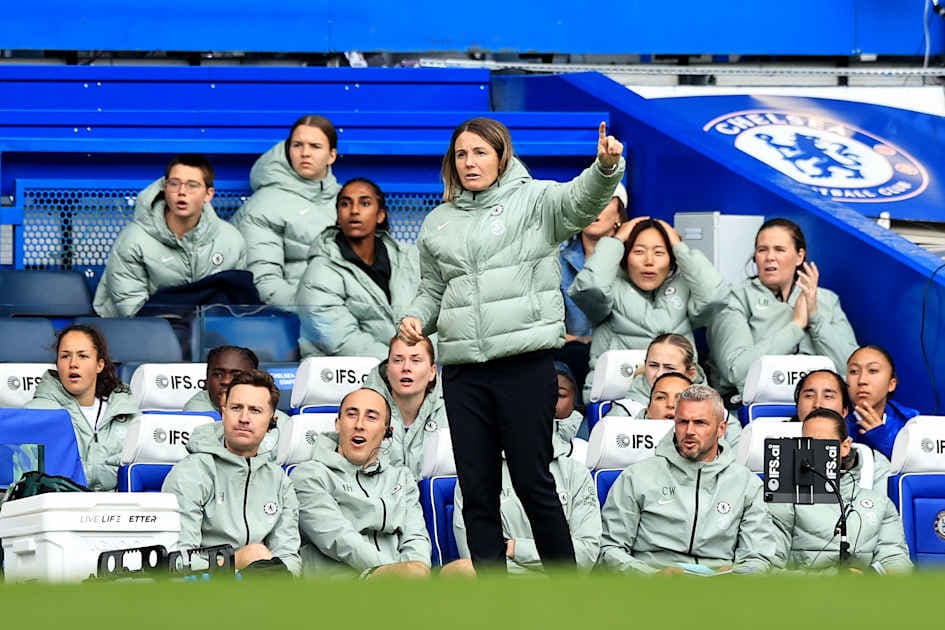
Chelsea's Transition: From Treble Winners to Seeking More
Chelsea know what dominance looks like. Sonia Bompastor arrived in the summer of 2024, swept to a domestic Treble in her first season, and appeared to slot seamlessly into the slipstream of success created in west London over the past decade.
This year has felt different.
The Women’s League Cup has been retained. A third-place finish has secured a return to the Women’s Champions League. The team is in the Women’s FA Cup semi-final. On paper, that is a season many clubs would frame and hang on the wall.
At Chelsea, it triggers a post-mortem.
From Treble winners to searching for more
Bompastor has never been shy about the standards she walked into. Chelsea’s recent history is littered with trophies, streaks of wins, and the sense that domestic silverware is the minimum, not the ceiling.
‘If you reflect in terms of results, for sure, we have been so used to winning so many games, trophies, and titles,’ she said. ‘But this season we couldn't achieve as much as we did previously.’
That is the crux. The bar is not set by the rest of the Women’s Super League, but by Chelsea’s own past. A Treble in year one. A more fractured, more demanding second campaign in which the trophies did not flow so freely, and the margins tightened.
Bompastor calls both seasons “transitional”. Few would have guessed that in the glow of that first-year Treble, but the French coach insists the club has been reshaping itself from the moment she walked through the door.
‘We have already started a lot of reflections within the club to make sure we are in a better place for next season. We knew we were coming into a transitional period since I joined the club.
‘The first season was really successful for us. This season, in terms of success, it was more difficult, but both seasons have been transitional seasons for the club.’
The pack closes in
The sense of transition is not only internal. Chelsea helped set the standard in the women’s game, and the rest of England – and Europe – has taken note.
‘The competition is becoming bigger and bigger,’ Bompastor said. ‘I think in terms of the gap between Chelsea and the other teams in England, but also in Europe. More teams are now able to invest in the women's game, to invest in their team, to invest in players to be able to compete against Chelsea.
‘Chelsea have been a club who have been showing the pathway. Right now, most of the clubs are catching up and making sure they can compete against us. So, it’s for us as a club to have a vision around, “okay, how can we maintain the success in the long term at a club like Chelsea?” That's the question we need to ask ourselves.’
That question hangs over everything. The days when Chelsea could simply outmuscle the league are fading. Investment has spread. Squads are deeper. Fixtures are tighter. Every dropped gear now carries a cost.
A new calendar, a different puzzle
Next season brings a structural shift as well. New rules mean that by qualifying for the Women’s Champions League, Chelsea will not take part in the League Cup in 2026/27.
One competition disappears. The pressure on the remaining three intensifies.
‘We have been competing in four competitions, and going into next season, there will be three competitions,’ Bompastor explained. ‘You build a squad to have the depth to compete in every competition, because when you have this level of quality in the team, you have a lot of international players, and they play many games in the season.’
The squad has been built for volume: four fronts, constant rotation, international travel, relentless turnarounds. Now the club must recalibrate that depth for a slightly leaner but sharper campaign, where the WSL and Europe will define the narrative.
The focus is clear: give Chelsea every possible tool to stand up to a WSL that no longer offers any easy weekends, and a Champions League that punishes even a single off-night.
No easy games now
Bompastor knows both sides of the European divide. At Lyon, she lived inside a dynasty that rolled through domestic fixtures almost on autopilot. England is not that.
‘I’ve said this before, but when you come here, you can see the difference between this league and all the other leagues in Europe. When I was at Lyon, 80 per cent of the games, we could play at 60 per cent, and it was enough for us to win.
‘I could play some of the games with players coming from the academy and still win games. That's not the case here. Here, you have to compete in every league game because every match brings you a challenge in different ways.’
There is no hiding place in the WSL. No quiet Saturday to ease through on half-power.
‘Sometimes it's a physical challenge. Sometimes it's a tough game because they are big clubs. Sometimes it's a tactical challenge. You need to make sure you are ready for every game. There is no space for you to drop a little bit because when you do that, you lose or you drop points.’
That reality has shaped this season and will dictate the next. Chelsea’s aura still carries weight, but it no longer guarantees control. Every fixture is a test of detail, fitness, and mentality.
And so the reflection Bompastor talks about is not a soft, end-of-season review. It is forensic.
‘Our job is to reflect and to make sure we make the right decisions for the future.’
The trophies on the shelf say Chelsea remain a force. The tightening margins say the era of automatic dominance is over. What comes next will show whether this has been a brief pause in the parade – or the start of a very different kind of race.
Related News

Raphinha’s Hat-Trick Powers Barcelona to 7-2 Victory Over Racing Santander
Carabao Cup Fourth Round Draw: Liverpool Set to Clash with Chelsea, Arsenal to Face Fleetwood Town
Key Football Matches to Watch in Azerbaijan This Autumn
Raphinha's Hat-Trick Drives Barcelona to 7-2 Triumph Over Racing Santander
Hansi Flick Leads Barcelona to Record-Breaking Seven Wins in a Row

Gavi Reflects on Injury Return as Barcelona Dominate Racing Santander 7-2