
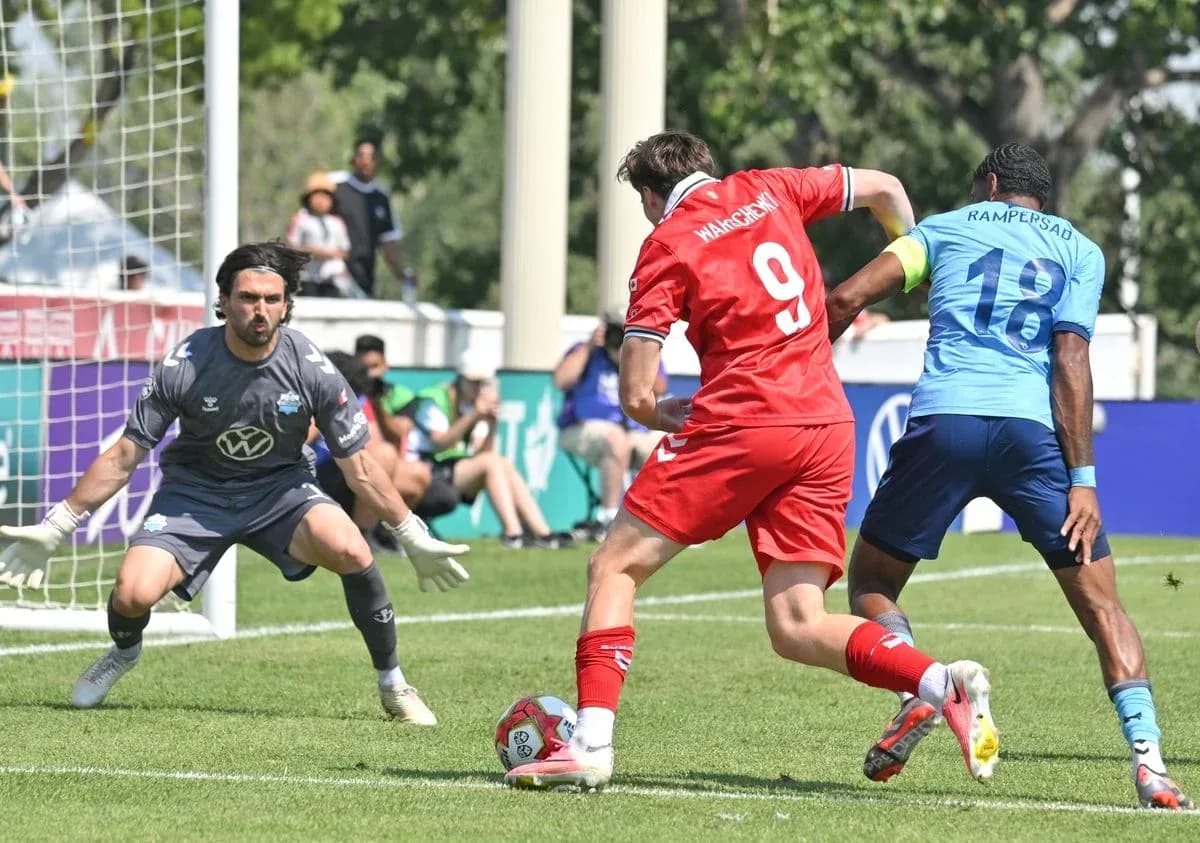
Cavalry FC Dominates HFX Wanderers in Canadian Premier League Clash
Under the lights at Wanderers Grounds, this Group Stage meeting in the Canadian Premier League brought together two clubs living very different versions of the same season. HFX Wanderers FC, 6th in the table with 20 points and a goal difference of -8 (29 scored, 37 conceded overall), faced a Cavalry FC side that has turned 2026 into a statement campaign: 1st place, 46 points, and a goal difference of 28 (40 scored, 12 conceded overall). The 3–1 away win for Cavalry underlined the gap, but the squads and shapes on show told a more nuanced tactical story.
Vanni Sartini leaned into HFX’s most trusted identity, rolling out the 4-3-3 that has been his most-used setup this season. The selection was bold: M. Carducci in goal behind a back four of Jefferson Alphonse, T. Meilleur-Giguère, F. Linder and R. Telfer. In front of them, a technical midfield trio of L. Callegari, L. Olguin and Isaiah Johnston, with a front three of Miguel Arilla, J. Bahamboula and A. Reid.
This XI captured HFX’s season in miniature. Johnston is their attacking heartbeat: 6 total league goals and 1 assist in 21 appearances, plus 20 shots with 17 on target. He is also combative, with 18 tackles and 10 interceptions, but his 5 yellow cards speak to the fine line he walks between aggression and overreach. Alongside him, Callegari is the metronome and shield, with 855 passes at 87% accuracy and 15 key passes, plus 23 tackles and 21 interceptions. He is both playmaker and breaker of play, but he too carries disciplinary weight with 5 yellows.
Olguin, still only 20, offers a quieter but important presence: 643 completed passes at 90% accuracy, 16 tackles and 10 interceptions, and 4 blocked shots. His 5 yellow cards underline that HFX’s central trio is intense, but vulnerable to bookings. That maps neatly onto the team profile: across the season HFX pick up a heavy share of yellow cards late, with 30.95% coming between 76–90 minutes and another 11.90% in added time (91–105). They chase games, and they pay for it.
Out wide, Arilla is the creative wildcard. With 4 total assists and 2 goals in 19 appearances, plus 12 successful dribbles from 23 attempts, he is HFX’s leading assister and their best hope of breaking Cavalry’s compact block. His 65 duels and 31 wins show a willingness to battle, but the relatively low passing accuracy (64%) hints that he thrives in chaos more than in structured possession.
On the bench, Sartini had genuine game-changing tools. Tavio Ciccarelli, with 3 total league goals in just 281 minutes and 4 shots on target from 5 attempts, is an impact substitute by design: 13 appearances from the bench, often introduced to attack tired legs. His disciplinary record is volatile—3 yellows and 1 second yellow—but his ability to win a penalty (1 won, 1 scored) makes him a late-game weapon. A. Rampersad offers leadership and ball-winning, while N. Pierre and Liam Mackenzie add fresh legs in forward and midfield zones respectively. Kareem Sow provides defensive cover, and S. Astridge is the reserve goalkeeper.
Across the touchline, Tommy Wheeldon Jr. named a Cavalry XI that looks every inch like a champion-in-waiting. The 4-2-3-1—already used 7 times this season—was anchored by N. Ingham in goal, behind a back four of A. Pearlman, D. Klomp, A. Didic and B. Kamdem. In midfield, Harrison Paton and Sergio Camargo formed the double pivot, with N. Myroniuk, Tobias Warschewski and N. Edwards supporting lone forward C. Elva.
Cavalry’s season numbers show why this structure is so hard to break. Overall they average 2.0 goals scored and just 0.6 conceded per match, with 8 clean sheets in 20 fixtures. On their travels they still score 1.7 per game and concede only 0.6. The centre-back pairing is elite at this level: Klomp has 586 passes at 91% accuracy, 10 interceptions, 5 blocked shots and 3 goals, while Pearlman adds 462 passes at 85%, 24 tackles, 4 interceptions and 2 assists. Pearlman’s 5 yellow cards show he is an aggressive front-foot defender, but his 55 duels won out of 83 underline his effectiveness.
Ahead of them, Paton is Cavalry’s enforcer and tempo-setter. With 309 passes at 84% accuracy, 18 tackles and 4 interceptions, plus 1 goal and 1 assist, he balances progression and protection. His 7 yellow cards and 19 fouls committed make him one of the league’s most card-prone players, a focal point in the disciplinary narrative. When the game becomes stretched, his duels with Johnston and Callegari decide whether HFX can play through the lines or are forced long.
Camargo, with 2 goals, 1 assist and 85% passing accuracy, is the more subtle half of the double pivot, drifting into pockets to link with Warschewski. Tobias Warschewski is the archetypal “Hunter” in this matchup: 4 total league goals, 2 assists, 25 key passes and 24 shots (14 on target) make him Cavalry’s most dangerous all-round attacker. He also wins 48 duels and draws 20 fouls, constantly putting defenders in awkward body positions. His duel with Meilleur-Giguère and Linder—both tasked with tracking his half-space movements—was always going to be decisive.
Out wide and between the lines, Goteh Ntignee (from the assists list), even if not starting here, remains a crucial part of Cavalry’s broader squad story: 2 goals, 2 assists, 16 successful dribbles and 95 duels contested embody the side’s aggressive, front-foot pressing and transition play. On the bench, Eryk Kobza adds a combative midfield presence (6 yellows and 1 second yellow), while Ali Musse brings creative depth with 2 assists and 13 key passes. C. Ofori and E. Kobza offer defensive solidity, O. Antoniuk another forward option, and J. Holliday goalkeeping cover. Notably, despite their combative profile, Cavalry have not missed a penalty this season (3 scored from 3), and neither have HFX (6 from 6).
The “Engine Room” battle at Wanderers Grounds was thus clearly drawn: Johnston, Callegari and Olguin trying to wrest control from Paton and Camargo. HFX’s overall scoring profile—1.4 goals per game in total, with 1.5 at home—suggests they can hurt teams, but their 1.8 goals conceded per match and only 4 clean sheets overall make them fragile when chasing. Cavalry, by contrast, are built to punish exactly that scenario, with a ruthlessly efficient attack and the league’s most secure defence.
Statistically, the prognosis before a ball was kicked pointed firmly toward Cavalry. Their away defensive average of 0.6 goals conceded per game set against HFX’s total attacking average of 1.4 hinted at a narrow margin for the hosts, while Cavalry’s total attacking average of 2.0 faced a defence conceding 1.8 per match. Over 90 minutes, that imbalance, combined with the visitors’ superior squad depth and structural stability, was always likely to tilt the contest. The 3–1 final scoreline simply confirmed what the numbers and the tactical matchups had already suggested: HFX could compete in moments, but Cavalry’s squad profile and defensive solidity make them the benchmark everyone else is still chasing.
Related News

Cavalry FC vs Forge: Intense Rivalry Returns to ATCO Field
Pacific FC vs Vancouver FC Prediction: Key Stats and Betting Tips

Cavalry FC vs Forge Prediction: Key Stats and Betting Tips

Cavalry FC Dominates Pacific FC in 1-0 Clash
York United Triumphs Over Vancouver FC in Canadian Premier League Clash

Atlético Ottawa vs Supra du Quebec Stats: Head-to-Head Record