
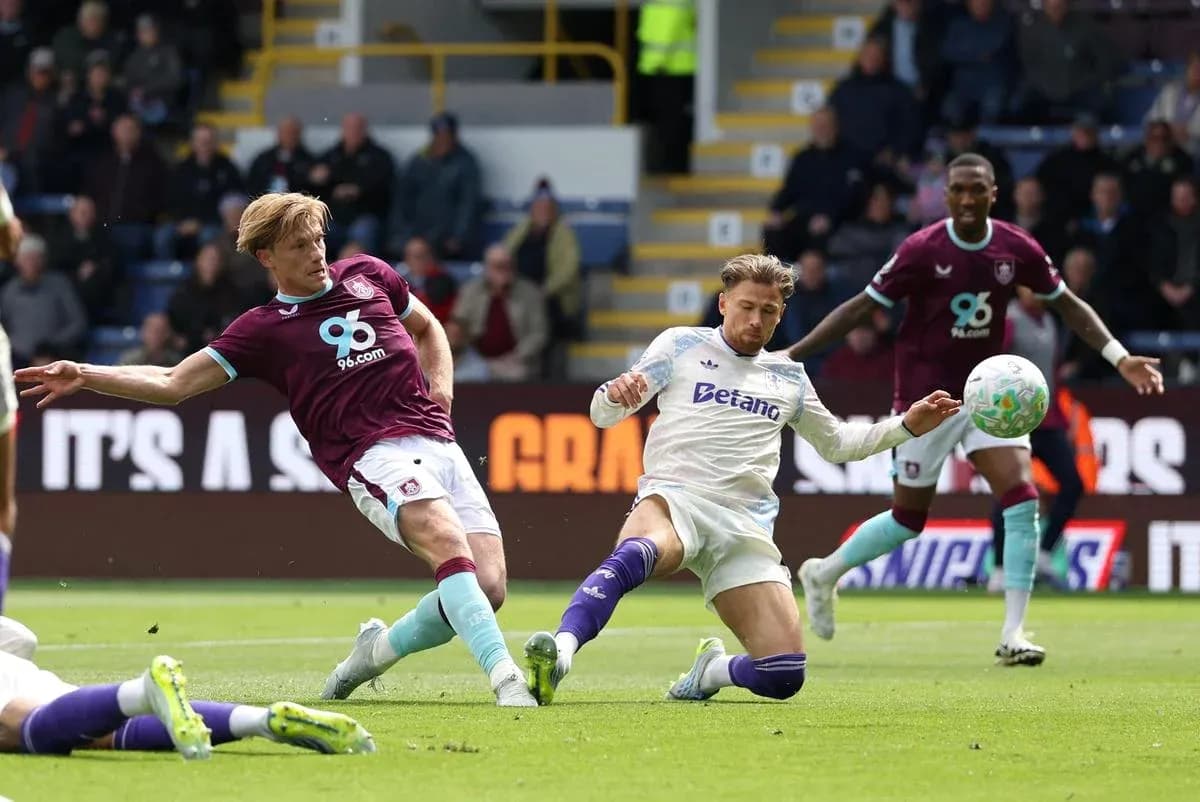
Burnley vs Aston Villa: A Crossroads Clash in the Premier League
Turf Moor felt like a crossroads rather than a routine May fixture. In a Premier League season where Burnley have been trapped in the relegation undertow and Aston Villa have pushed on towards the Champions League places, a 2-2 draw in round 36 told a story of two clubs pulling in opposite directions yet meeting in the same moment of jeopardy.
Heading into this game, the table framed the contrast starkly. Burnley were 19th with 21 points, their goal difference of -36 the arithmetical scar of a campaign in which they had scored 37 and conceded 73 overall. At home they had taken just 2 wins from 18, with 17 goals for and 28 against, averaging 0.9 goals scored and 1.6 conceded at Turf Moor. Aston Villa arrived in fifth on 59 points, with a goal difference of +4 built from 50 goals for and 46 against overall. On their travels they had been patchy but respectable: 6 away wins, 6 draws, 6 defeats, scoring 22 and conceding 26, an average of 1.2 goals scored and 1.4 conceded away from home.
Both coaches leaned into familiarity. Mike Jackson returned to Burnley’s most-used shape this season, a 4-2-3-1 that has started 11 league matches. Unai Emery did the same, naming yet another Villa XI in the 4-2-3-1 that has underpinned 32 of their league outings. Systems mirrored, but intentions diverged.
For Burnley, the tactical voids were as much about absentees as about structure. The injury list stripped away important strands of continuity. J. Beyer’s hamstring injury removed a centre-back option in a team already conceding 2.0 goals per game overall. J. Cullen’s knee problem deprived Jackson of a metronome in midfield, a loss keenly felt in a side that often struggles to control games. C. Roberts’ muscle injury weakened full-back depth in a campaign where defensive cohesion has been fragile.
Villa had their own absences to manage. Alysson’s muscle injury, B. Kamara’s knee issue and A. Onana’s calf problem trimmed Emery’s options in the middle and at the base of midfield. In response, he pushed V. Lindelof into a screening role ahead of the back four, a pragmatic tweak designed to steady a team that, for all its attacking verve, still concedes 1.3 goals per game overall.
The lineups on the day reflected those compromises. Burnley’s back four of K. Walker, A. Tuanzebe, M. Esteve and Lucas Pires sat in front of M. Weiss, with Florentino and L. Ugochukwu as the double pivot. Ahead of them, L. Tchaouna, H. Mejbri and J. Anthony supported lone forward Z. Flemming. It was a selection that leaned heavily on Flemming’s season-long productivity: 10 league goals overall, including 2 penalties scored from 2 taken, and a willingness to work without the ball, evidenced by 15 tackles and 5 blocked shots.
Villa’s response was to trust their stars. E. Martinez anchored a defence of M. Cash, E. Konsa, T. Mings and I. Maatsen. Lindelof and Y. Tielemans formed the double pivot, while J. McGinn, R. Barkley and M. Rogers played behind O. Watkins. Between them, Watkins and Rogers have defined much of Villa’s attacking edge this season: Watkins with 12 goals and 2 assists overall, Rogers with 9 goals and 5 assists, plus 43 key passes and 117 dribble attempts that mark him out as the primary carrier between the lines.
Key Duels
The “Hunter vs Shield” duel was written clearly. Watkins, with 51 shots and 31 on target this campaign, arrived as one of the league’s most persistent forwards, facing a Burnley defence that had already shipped 73 goals overall and 28 at home. Burnley’s shield was less a single player than a collective necessity, but in individual terms Walker and Tuanzebe were central. Walker, who has made 53 tackles, 10 blocked shots and 43 interceptions this season, was tasked with containing Watkins’ diagonal runs into the channels, while Tuanzebe and Esteve had to handle his back-to-goal play.
At the other end, Flemming was Burnley’s hunter. His 37 shots and 20 on target, plus a willingness to attack second balls, posed questions of a Villa defence that, on their travels, concedes 1.4 goals per game. The duel with Konsa and Mings was as much psychological as physical: Villa know they can be exposed in transitions, particularly when their full-backs push high.
Engine Room Battle
The “Engine Room” battle revolved around M. Rogers and Y. Tielemans on one side, Florentino and Ugochukwu on the other. Rogers’ 1033 passes and 43 key passes overall show how often Villa funnel play through his feet, while his 40 tackles and 3 blocked shots underline his work without the ball. For Burnley, Florentino’s screening and Ugochukwu’s ability to break lines were vital in preventing Villa from suffocating them centrally.
Discipline Overview
Discipline hovered over everything. Burnley’s season-long card profile shows a tendency towards volatility: yellow cards spike in the 16-30’ and 76-90’ windows at 19.67% each, with red cards spread across 31-45’, 76-90’ and 91-105’ at 33.33% apiece. K. Walker, with 9 yellows overall, and J. Laurent, who has already seen red once this season, embody that edge. Villa, by contrast, tend to collect yellows in the 46-60’ period (29.09%), a sign of how aggressively they start second halves, while their only red has come in the 61-75’ window. In a match that finished level, the fact that both sides stayed at eleven men allowed the tactical patterns to play out fully.
From a statistical prognosis standpoint, a 2-2 draw felt aligned with the underlying numbers. Burnley’s home attack, averaging 0.9 goals per game, punched slightly above its weight, but not wildly so against a Villa side that concedes 1.4 away. Villa’s overall attacking profile of 1.4 goals per game translated into two goals against a defence that leaks 2.0 overall; it was, in essence, the mean expressed in 90 minutes.
Following this result, the trajectories remain distinct. Burnley, marooned in 19th with a goal difference of -36 (37 scored, 73 conceded), will take solace from the resilience and from Flemming’s continued influence, but the structural issues that have defined their season persist. Villa, still fifth with a goal difference of +4 (50 scored, 46 conceded), will rue dropped points yet again on their travels, but can point to the continued productivity of Watkins and Rogers as proof that their attacking framework remains robust.
In narrative terms, this was a match where the underdog refused to bow to the weight of the table and where the favourite’s familiar flaws resurfaced. In tactical terms, it was a mirror-formation chess match in which the hunters on both sides found just enough space, and the shields on both sides just enough cracks, to leave Turf Moor with a scoreline that felt both chaotic and strangely inevitable.
Related News
Bournemouth vs Liverpool Prediction: Key Stats and Betting Tips

Tottenham vs Aston Villa Predicted Lineups: Team News for Premier League Clash
Brighton vs Arsenal: Premier League Clash Preview

Manchester City vs Sunderland: Premier League Clash Preview
Tottenham vs Aston Villa: Early Relegation Battle

Brentford vs Chelsea Predicted Lineups: Team News and Match Insights