
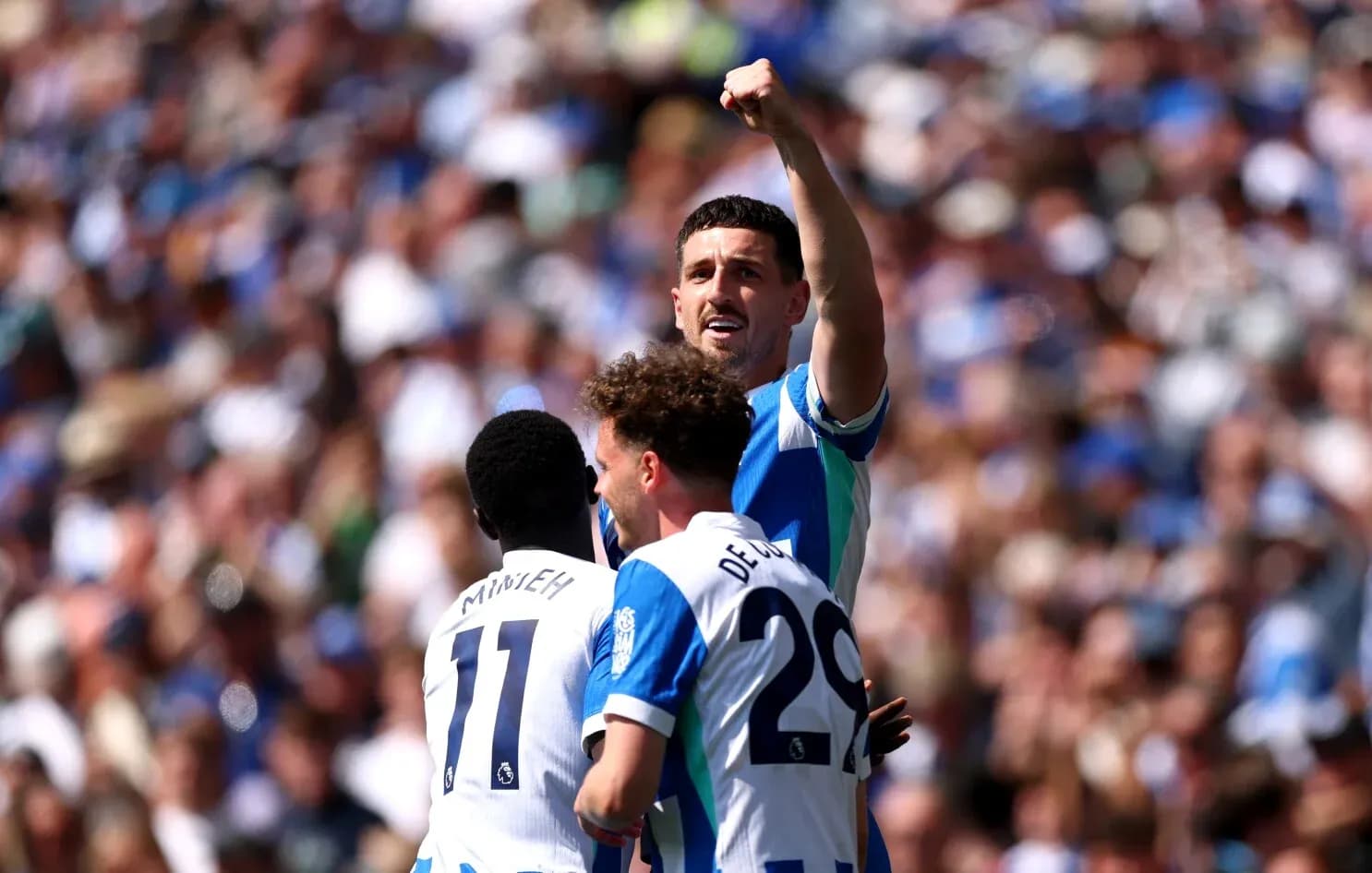
Brighton Dominates Wolves in 3–0 Victory at Amex Stadium
Brighton’s 3–0 home win over Wolves at the Amex Stadium was a clinic in territorial dominance and structured possession. In a Premier League Round 36 fixture, Fabian Hurzeler’s side jumped to a 2–0 lead inside five minutes and then used the ball to suffocate any Wolves response, finishing with 72% possession and a 14–5 shot advantage. The hosts’ passing control and wide overloads repeatedly stressed Rob Edwards’ compact but reactive 5‑3‑2/5‑4‑1 defensive block, while Wolves’ limited counter-attacking threat never translated into sustained pressure, reflected in just one shot on target and 0.49 xG.
The scoring sequence underlined Brighton’s aggressive start. At 1', Jack Hinshelwood arrived from midfield to finish a move created down the left, assisted by Maxim De Cuyper. Four minutes later, Lewis Dunk doubled the lead, again from a De Cuyper delivery at 5', exploiting Wolves’ early disorganisation on set or crossing situations. The first disciplinary action came at 24': Kaoru Mitoma (Brighton) — Foul. That was Brighton’s only card.
Wolves’ first structural change came at 46', when David Møller Wolfe (IN) came on for Hugo Bueno (OUT), aiming to stabilise the left flank and support progression. Their frustration in attack began to show in discipline: at 49', Hwang Hee-chan (Wolves) — Foul. Edwards then made a double attacking adjustment at 67': Rodrigo Gomes (IN) came on for Pedro Lima (OUT), and Jean-Ricner Bellegarde (IN) came on for Mateus Mané (OUT), seeking more direct running and creativity between the lines. Almost immediately, another booking followed at 68': André (Wolves) — Foul.
Hurzeler managed Brighton’s energy with controlled substitutions. At 58', Joël Veltman (IN) came on for Kaoru Mitoma (OUT), tightening the right side defensively and allowing the structure to tilt left through De Cuyper. At 76', Yasin Ayari (IN) came on for Carlos Baleba (OUT), and Georginio Rutter (IN) came on for Danny Welbeck (OUT), refreshing the central and forward zones without altering the 4‑2‑3‑1/4‑3‑3 spacing.
Brighton’s third goal at 86' came from the right: Yankuba Minteh drove and finished a “Normal Goal” with no listed assist, capping a performance built on isolation and 1v1 superiority against a tiring Wolves back line. Game management followed: at 88', Charalampos Kostoulas (IN) came on for Jack Hinshelwood (OUT), and Solly March (IN) came on for Maxim De Cuyper (OUT), preserving key contributors. Wolves’ final changes at 89' — Angel Gomes (IN) for Hwang Hee-chan (OUT) and Tolu Arokodare (IN) for João Gomes (OUT) — came too late to alter the pattern.
Tactical Overview
Tactically, Brighton’s dominance started with their build-up. With no formation listed, the personnel and patterns point to a back four of Ferdi Kadıoğlu, Jan Paul van Hecke, Lewis Dunk and Maxim De Cuyper in front of Bart Verbruggen. Dunk and van Hecke split wide, Baleba dropped to form a three in the first phase, and Pascal Groß acted as the tempo-setter between lines, supported by Hinshelwood’s vertical runs. The 578 total passes at 86% accuracy show a team comfortable circulating under minimal pressure, repeatedly shifting Wolves’ block laterally.
The left side was Brighton’s main progression lane. De Cuyper’s early two assists indicate how often he received high and wide, with Mitoma inside to drag markers and Welbeck pinning the centre-backs. Wolves’ right side of Santiago Bueno and Pedro Lima struggled to manage the dual threat of overlaps and underlaps, particularly in the opening minutes before they could settle their distances. After Mitoma’s substitution, Veltman’s more conservative profile allowed Brighton to lock rest defence, with Kadıoğlu or Minteh higher on the opposite flank to stretch horizontally.
Defensive Strategy
Out of possession, Brighton’s defensive index was built on control rather than volume: only 9 fouls and 1 yellow card suggest they defended more through counter-pressing and positioning than through last-ditch interventions. Verbruggen faced just 1 shot on target and made 1 save, with 0.25 goals prevented, underlining how rarely Wolves accessed high-value zones. Dunk’s early goal and aerial presence also meant Brighton could defend set plays with authority while still committing numbers forward.
Wolves' Approach
Wolves’ approach was reactive. With just 225 passes at 68% accuracy and 28% possession, they sat in a compact mid-to-low block, trying to spring Armstrong, Hwang Hee-chan and Mané in transition. The problem was progression through midfield: André and João Gomes were forced into rushed passes or long balls under Brighton’s press, leading to turnovers and feeding Brighton’s second-phase attacks. Their 5 total shots (4 inside the box) show that when they did reach advanced areas, it was sporadic and without sustained waves of pressure.
Edwards’ substitutions were logical but insufficient. David Møller Wolfe for Hugo Bueno aimed to stabilise the left, but Brighton’s control of central spaces meant Wolves rarely advanced that flank. Rodrigo Gomes and Jean-Ricner Bellegarde added ball-carrying and half-space presence, yet with Brighton still dominating the ball, their influence was mostly in brief counters. The late introduction of Angel Gomes and Tolu Arokodare at 89' was more about minutes and shape experimentation than a genuine tactical swing.
Statistical Summary
Statistically, the verdict is emphatic. Brighton’s 1.62 xG to Wolves’ 0.49 aligns closely with the 3–0 scoreline when contextualised by shot quality and game state: an early 2–0 lead allowed Brighton to control tempo and select their moments to attack, while Wolves were forced into low-probability efforts. Brighton’s 6 shots on goal to Wolves’ 1 and 7–1 corner advantage illustrate territorial control and sustained pressure. Defensively, both keepers posted 0.25 goals prevented, but the workloads were starkly different: Verbruggen’s 1 save versus Daniel Bentley’s 3, behind a defence that faced 14 shots and constant circulation.
Discipline was also tilted but controlled: Brighton finished with 1 yellow card, Wolves with 2, total 3. That imbalance reflects Wolves’ increasing frustration and late, chasing defensive actions rather than any chaotic edge to the match. Overall, Brighton’s performance combined high-possession overall form with a calm defensive index, turning structural superiority into a comfortable, data-backed home victory.
Related News
Tottenham vs Aston Villa Predicted Lineups: Team News for Premier League Clash
Brighton vs Arsenal: Premier League Clash Preview
Manchester City vs Sunderland: Premier League Clash Preview
Tottenham vs Aston Villa: Early Relegation Battle

Brentford vs Chelsea Predicted Lineups: Team News and Match Insights
Brighton vs Arsenal Prediction: Key Stats and Betting Tips