
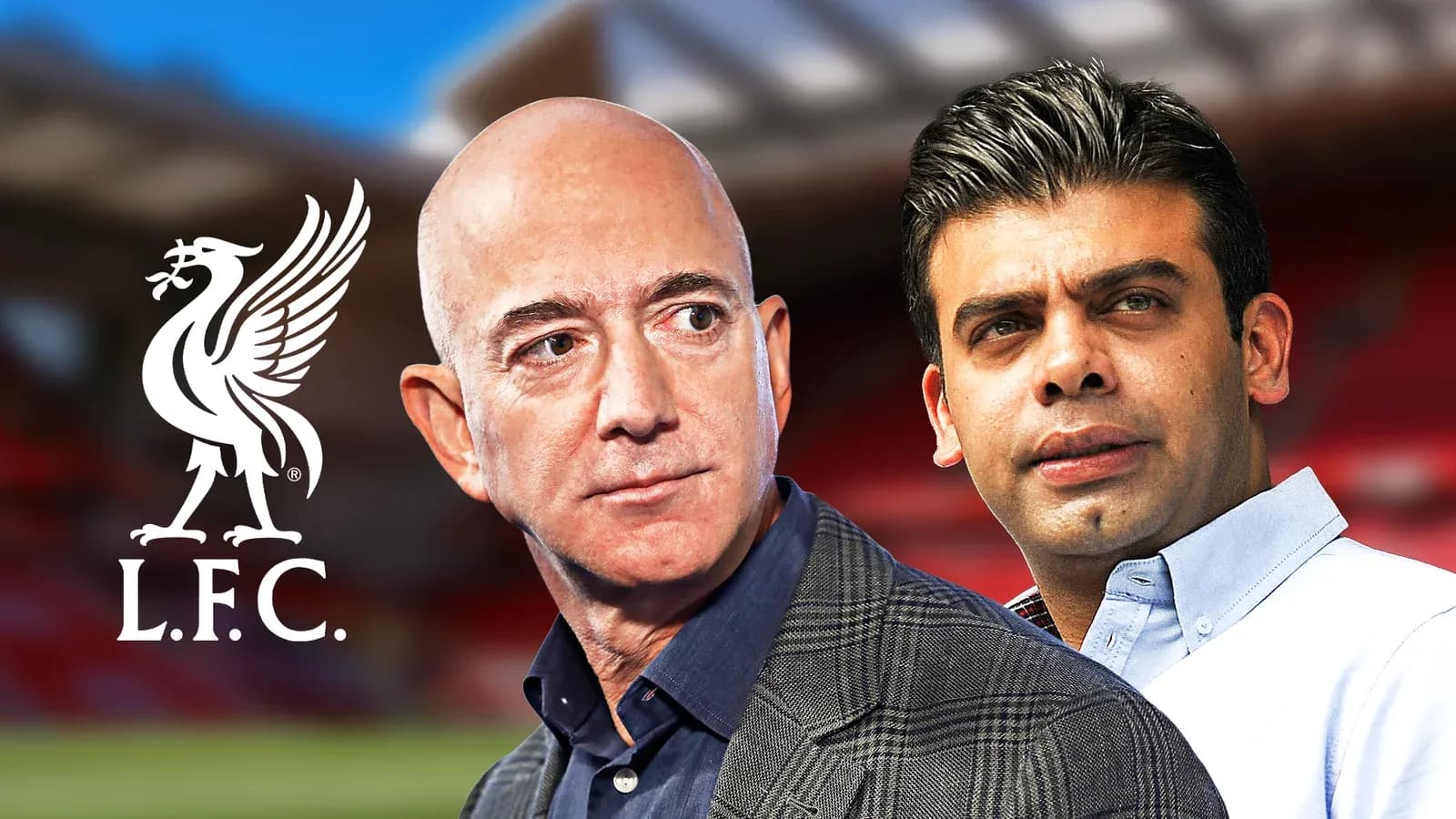
Bezos Joins Liverpool in Landmark Investment Deal
Liverpool have sold around a third of the club to a heavyweight consortium featuring Amazon founder Jeff Bezos, in a landmark deal that drags one of English football’s grandest institutions even deeper into the orbit of global billionaires.
The investment group is led by Amit Bhatia, the British-Indian entrepreneur and former Queens Park Rangers shareholder, with Bezos joining as part of the wider syndicate. Fenway Sports Group (FSG) remains in charge, but the scale and profile of the new money changes the backdrop around Anfield overnight.
This is not a takeover. It is a statement of intent.
A £6bn–£7bn valuation and a new tier of wealth
The agreement values Liverpool at roughly £6bn ($6–7bn), placing the club among the most richly valued assets in world sport. The consortium is acquiring about 30 per cent, in what has been framed as a long-term, minority partnership rather than a stepping stone to full control.
Bezos, whose personal fortune Forbes estimates at over £207bn ($280bn), steps into sports ownership for the first time. He will not sit on Liverpool’s board; that role falls instead to Bhatia, who will become vice-chair.
The deal installs some of the world’s wealthiest figures alongside FSG at a club that already sees itself as a global superpower. The question now is how that power is used.
FSG: control stays in Boston, ambition stretches worldwide
FSG were quick to stress what is not changing. Majority ownership and day-to-day operational control stay with John W Henry’s group. There is no shake-up of the leadership structure, no new sporting hierarchy, no sudden shift in the club’s footballing doctrine.
In a statement, FSG said the agreement “supports Liverpool's long-term growth ambitions by bringing together experts from across global business, technology, and investment,” adding that the consortium will work with FSG and the club’s leadership “to evaluate opportunities that enhance the club's objectives on and off the pitch”.
Mike Gordon, FSG president, underlined the continuity of approach, insisting Liverpool has “always been built by thinking beyond one season and making decisions with the club's long-term interests in mind”. He said it became clear during talks that Bhatia and the consortium “shared our long-term philosophy and appreciation for what makes Liverpool special,” and that their experience would “complement the strong foundation already in place”.
Bhatia, for his part, described the group as “proud to be investing in Liverpool”.
No transfer war chest, no quick fixes
For supporters dreaming of a sudden, Saudi-style transfer spree, the cold water came quickly.
Sky Sports News’ Vinny O’Connor described the move as a “minority investment and a long-term partnership,” and made it clear there is “no new or separate transfer budget associated with this investment at all”. Liverpool’s sporting department will continue to set transfer policy and budgets within the existing financial sustainability model.
Liverpool were not driven to the table by financial distress. FSG were looking for the right kind of capital and the right kind of partners. The sheer profile and financial clout of Bezos and Bhatia’s group convinced them this was the right fit.
So, the pressure to rip up the transfer strategy simply is not there. Nor, at this stage, is the will.
Who are the new power players?
Bhatia, 46, brings a blend of City experience and global connections. An investment banker by background, he runs AyBe Capital, a multi-asset investment firm with interests spanning technology, media, property and real estate, consumer retail, and health. He is married to Vanisha Mittal Bhatia, daughter of Indian steel magnate Lakshmi Mittal, one of the wealthiest industrialists on the planet.
Bezos needs little introduction. He built Amazon from a garage operation in Seattle in 1994 into an e-commerce behemoth and one of the defining companies of the modern era. His portfolio stretches from aerospace firm Blue Origin to Nash Holdings, the vehicle through which he owns The Washington Post.
Now his name sits alongside Liverpool on the global stage.
A club rooted in tradition, wired for the future
Strip it back and the fundamentals remain. FSG still call the shots. The football philosophy stays intact. The transfer model does not suddenly morph into a bottomless pit of cash.
Yet the landscape around Liverpool has shifted. A club that once drew its strength from the docks and terraces of a working city now finds itself backed by some of the most powerful figures in business and technology.
If this really is, as O’Connor puts it, a “long-term partnership”, the intrigue lies not in what changes tomorrow, but in what Liverpool might look like five, ten years from now, with this kind of capital and expertise plugged into Anfield’s ambitions.
Related News
Transfer Rumors: Haaland’s Two Options; Real Madrid Targets $100 Million Premier League Star
Manchester United Targets Premier League Forward to Strengthen Attack
Liverpool Eyes 17-Year-Old Mexican Midfielder Gilberto Mora for Summer Transfer
Summer 2026 Transfer Window: Manchester United and Tottenham Struggle with New Signings
Liverpool Maintain Interest in Real Madrid Midfielder Amid Transfer Challenges
Transfer Insider Warns Tottenham About Costly Sale of Will Lankshear