
Bayern Munich Triumphs: Brown and Olise Shine in Supercup
Bayern Munich have their first trophy of the 2026/27 campaign, and they earned it in classic fashion: ruthless in the big moments, just shaky enough at the back to keep Signal Iduna Park on edge.
A 2-1 win over Borussia Dortmund in the Franz Beckenbauer Supercup sounds tight. For 45 minutes, it wasn’t. Nathaniel Brown and Michael Olise fired Bayern into a deserved 2-0 lead, and by the time Fabio Silva finally dragged BVB back into it, the damage was done.
The evening, though, told a deeper story – about Manuel Neuer’s evolving game, Bayern’s surprising No. 10, Niko Kovac’s tactical gamble, and a striker who might be playing his way out of Dortmund.
Neuer: still world class, still a risk
Manuel Neuer has always lived on the edge. It’s what made him a revolutionary goalkeeper. It’s also what now makes Bayern nervous every time the ball rolls towards his feet.
The warning signs have been there. The glaring error to Arda Güler at the Bernabéu in April, gifting Real Madrid a Champions League quarter-final lead, still lingers in the memory. In Dortmund, the pattern reappeared.
After 15 minutes, Neuer tried to thread a pass into Min-jae Kim and got it wrong. Badly. The ball invited pressure, BVB pounced, and only Kim’s sharp reaction prevented an early gift-wrapped opener. The centre-back spared his captain a long, uncomfortable inquest.
Late on, Neuer put himself in trouble again. Kim rolled a routine back-pass towards him, and the 38-year-old tried to be cute, letting Jobe Bellingham run past with a feint behind his standing leg. The trick failed. Suddenly Bellingham had a clear sight of goal and the stadium roared in anticipation.
Neuer bailed himself out with the kind of intervention that built his legend: a fearless dive at Bellingham’s feet, smothering the chance before a shot could be taken. Outstanding reflexes, brilliant timing – and entirely unnecessary if he doesn’t invite the chaos in the first place.
He has hinted this could be his final season. Bayern have already lined up Jonas Urbig as the heir, and the 23-year-old is expected to see more minutes as the year wears on. Neuer is still pencilled in for the biggest games, but his distribution has become a recurring source of anxiety. The question now is whether those high-risk moments appear often enough to justify giving Urbig the stage even when the stakes are highest.
What hasn’t changed is Neuer on his line. Early in the second half, Konstantinos Karetsas looked certain to drag Dortmund back into the game from close range. Neuer reacted in a flash, contorting his body to claw away an awkward effort that seemed destined for the net. The instincts are still elite. It’s everything that happens 20 yards from goal that keeps Bayern hearts in mouths.
Brown the surprise No. 10 – and Bayern’s new trump card
Nathaniel Brown arrived in Munich as a left-back. He left Dortmund with a goal, a medal, and a new reputation as Vincent Kompany’s tactical joker.
With Jamal Musiala absent due to his neurological issues and Ismael Saibari not yet ready to start, most expected Tom Bischof to operate behind Harry Kane. Kompany went another way. Brown, the nominal full-back, lined up as the central No. 10.
It wasn’t a wild experiment plucked from nowhere. Pre-season had already shown Brown popping up as a No. 6 and even as a playmaker in the pocket. Kompany sees patterns, not positions, and he explained the logic afterwards: the spaces his full-backs attack can mirror those of a classic No. 10. Brown reads those zones superbly.
In Dortmund, that vision paid off. The 23-year-old still looked like a player learning the nuances of the role – a few movements not quite in sync, a couple of combinations slightly off – but he was constantly available between the lines, constantly asking questions.
And then he delivered the opener. A sharp, eye-catching finish that settled Bayern’s early nerves and underlined why the club were so keen to bring him in. First game of note, first trophy, first big goal. Not bad for a “left-back”.
His versatility gives Bayern something they lacked last season: genuine depth that doesn’t disrupt the system. Brown can cover at full-back, sit as a holding midfielder, or step into the playmaking role. Konrad Laimer offers similar flexibility across both flanks and the entire midfield axis. Josip Stanisic can slot in on either side and even at centre-back.
For a squad that will be stretched across four competitions, those Swiss Army knife profiles matter. On Saturday, Brown showed he might be the sharpest of the lot.
Kovac’s inverted wing-backs: bold idea, mixed returns
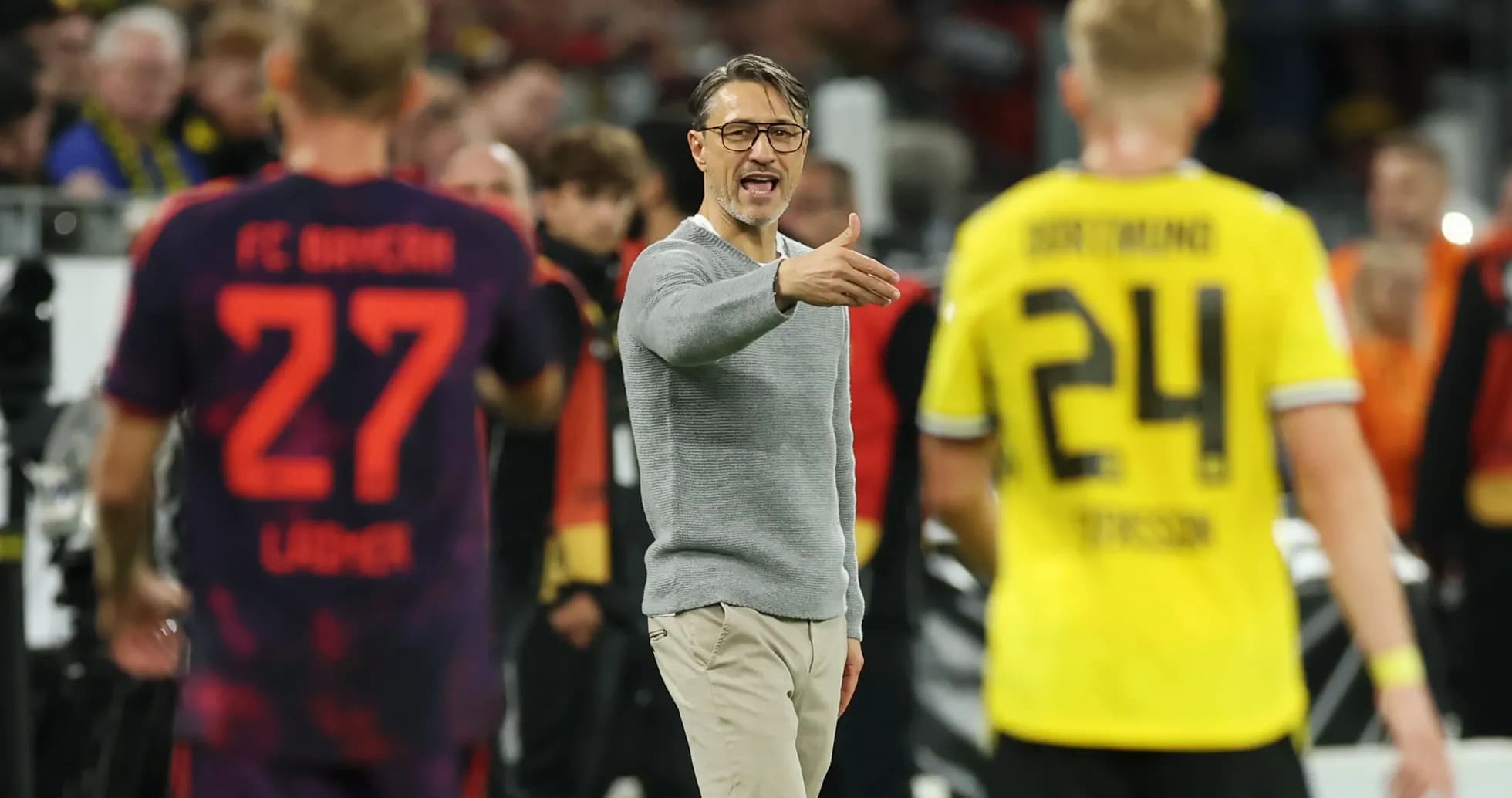
On the opposite bench, Niko Kovac used the Supercup as a testing ground. His idea: flip the wing-backs. Left-footed Daniel Svensson on the right. Right-footed Julian Ryerson on the left.
The logic was clear. With inverted wing-backs, Dortmund could drive inside, threaten with shots and cut-backs, and mimic the patterns that define Europe’s top attacking sides. Kovac laid it out plainly afterwards: if you play left on the left and right on the right, you go around the outside and cross. Switch them, and the inside lane opens.
At times, it worked. In the first half, Ryerson drifted into the left half-space and bent a teasing cross with his stronger right foot towards the far post. Ramy Bensebaini met it with the faintest of flicks, glancing the ball into the net. The stadium exploded – then fell silent. Offside. Marginal, but correct.
The problems with the tweak surfaced just as clearly. With the wing-backs on their “wrong” sides, Dortmund’s wide play sometimes looked clogged, a half-second slow. The natural runs to the byline weren’t there as often, the timing of overlaps suffered, and some promising attacks died on the edge of the box.
One moment before the break summed it up. Bensebaini drilled a low ball in from the left. It found Svensson, who had drifted in from the right, perfectly placed near the penalty spot. Right situation, wrong foot. Forced onto his weaker right, Svensson misjudged the timing completely and swung at nothing but air. Put Ryerson there on his stronger side and that chance looks very different.
Kovac saw enough. At half-time, he sent Svensson and Ryerson back to their natural flanks. The effect was immediate. Dortmund’s attacks gained width and bite, the runs in behind came more often, and Bayern’s back line had to scramble more frequently.
The 2-1 goal came from exactly the kind of move the first-half experiment had suppressed. Svensson, now back on the left, burst to the byline and cut the ball back intelligently. Fabio Silva arrived in the right pocket of space and did the rest. Clean, clinical, and rooted in the basics: left-footer on the left, hitting the right pass at the right time.
Kovac’s tweak isn’t dead. The upside is obvious. But the Supercup showed the downside just as starkly – and in a season where margins will be thin, he will have to pick his moments carefully.
Fabio Silva’s statement in the shop window
While Serhou Guirassy’s future looks increasingly settled, his performance against Bayern dragged up old concerns. The 30-year-old ran, pressed, and battled, but rarely threatened. He drifted out of the game, his influence shrinking as Bayern tightened their grip.
After a little over an hour, Kovac made the call. Guirassy off, Fabio Silva on. The change transformed Dortmund’s presence in the box.
Silva has shown flashes in his first year at BVB, but not enough to cement a starting spot. On Saturday, he played like a man who knows the window is closing – both in terms of the match and his future at the club.
For his goal, he dropped off the front line at just the right moment, finding a pocket of space as the move developed. When Svensson’s cut-back arrived, Silva didn’t hesitate. One touch, ruthless finish from close range. No drama, no overcomplication. Just a striker doing exactly what he’s paid to do.
That single moment could shift his status. Several clubs are circling, with Betis Sevilla among those most strongly linked. Silva is reportedly not fixed on staying in Dortmund, and the club’s hierarchy would be open to a sale if the right offer lands.
But time is running out in the window. Performances like this complicate the equation. Sell him now, and BVB must scramble for a replacement who understands Kovac’s demands and can hit the ground running. Keep him, and they may have a genuine weapon for the season’s second half.
For now, his goal has done two things: it tightened a Supercup that Bayern had under control, and it forced Dortmund’s decision-makers to think twice before cashing in.
Bayern left with the trophy and a familiar feeling: sharper in both boxes, deeper in options, still leaning on Neuer’s brilliance and living with his risk. Dortmund walked away with questions – about their structure, their finishing hierarchy, and whether one of their most effective forwards will still be there when the real battles begin.
Related News
Transfer Rumors: Haaland’s Two Options; Real Madrid Targets $100 Million Premier League Star
Manchester United Targets Premier League Forward to Strengthen Attack
Liverpool Eyes 17-Year-Old Mexican Midfielder Gilberto Mora for Summer Transfer
Summer 2026 Transfer Window: Manchester United and Tottenham Struggle with New Signings
Liverpool Maintain Interest in Real Madrid Midfielder Amid Transfer Challenges
Transfer Insider Warns Tottenham About Costly Sale of Will Lankshear