
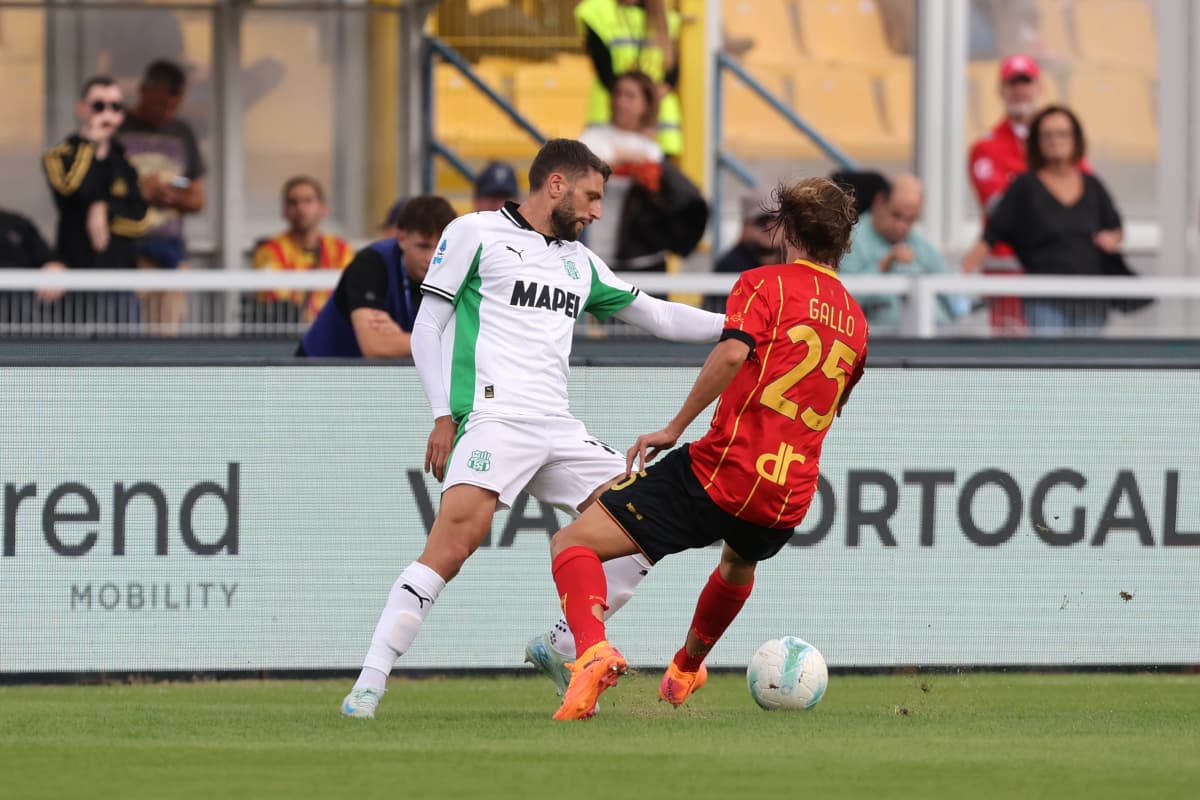
Sassuolo vs Lecce: A Chaotic Serie A Clash Ends 3–2
The lights have gone out on the penultimate evening at MAPEI Stadium – Città del Tricolore, and with them a wild, open Serie A contest that finished 3–2 to Lecce. Following this result, the table tells a sharp story: Sassuolo remain 11th on 49 points with a goal difference of -3 (46 scored, 49 conceded), while Lecce, 17th on 35 points and a goal difference of -23 (27 for, 50 against), drag themselves a vital step closer to safety after 37 matches.
I. The Big Picture – Two Identities, One Chaotic Night
This was a meeting of two very different seasonal profiles.
Sassuolo have lived this campaign on the front foot. Overall they have scored 46 goals and conceded 49, a negative goal difference but one that underlines their commitment to attack. At home they have been more productive, with 25 goals at an average of 1.3 per match, though they also allow 1.4 goals per game on their own turf. Fabio Grosso has leaned heavily on a 4-3-3 – used 35 times – and he kept faith with that shape again: S. Turati behind a back four of W. Coulibaly, Pedro Felipe, T. Muharemovic and U. Garcia; a midfield of K. Thorstvedt, N. Matic and I. Kone; and a front three of D. Berardi, M. Nzola and A. Laurienté.
Lecce arrived with a very different statistical DNA. Heading into this game, they had scored just 27 times in total, with a modest away average of 0.8 goals per match, while conceding 50 overall at 1.4 per game. Survival has been their obsession, not spectacle. Eusebio Di Francesco set them up in a 4-2-3-1: W. Falcone in goal; a back four of D. Veiga, J. Siebert, Tiago Gabriel and A. Gallo; a double pivot of Y. Ramadani and O. Ngom; an advanced trio of S. Pierotti, L. Coulibaly and L. Banda behind lone forward W. Cheddira.
The 2–3 scoreline was, in many ways, a collision of those identities: Sassuolo’s openness and flair against Lecce’s reactive, survivalist edge.
II. Tactical Voids – Who Was Missing, and What That Meant
Sassuolo’s squad sheet carried a quiet list of absentees that shaped Grosso’s options. D. Boloca (muscle injury) and F. Cande, E. Pieragnolo (both knee injuries) removed rotation options in midfield and at full-back. F. Romagna and A. Vranckx were listed as inactive, while S. Walukiewicz’s leg injury further thinned the defensive pool. It forced Sassuolo to lean even harder on the ball-playing security of Matic and the all-action presence of Thorstvedt in the middle, with little like-for-like cover on the bench.
Lecce’s absences were fewer but still notable. M. Berisha (thigh injury) and R. Sottil (back injury) were unavailable, restricting Di Francesco’s ability to alter the attacking mix from the bench. That placed greater responsibility on the starting quartet behind Cheddira, particularly the volatility and direct running of Banda.
Disciplinary tendencies also hung over this fixture. Sassuolo are a late-card team: 29.63% of their yellow cards come in the 76–90 minute window, part of a broader pattern of emotional, high-tempo endings. Lecce share that late-game edge, with 29.85% of their yellows also arriving from 76–90 minutes. Add in high-card individuals – Thorstvedt with 8 yellows, Ramadani and Danilo Veiga with 9 each, and red-card histories for Matic, Berardi, L. Banda, Kialonda Gaspar and A. Pinamonti – and this was always likely to become a spiky, combustible contest as fatigue set in.
III. Key Matchups – Hunter vs Shield, Engine Room Battles
The “Hunter vs Shield” axis for Sassuolo was led by A. Pinamonti in absentia from the XI but very present in Lecce’s pre-match planning. With 9 total league goals and 3 assists from 35 appearances, he remains Sassuolo’s leading scorer, even if he started this one on the bench. His 57 shots (30 on target) and ability to win 97 of 250 duels make him a classic penalty-box reference point, and Lecce’s central defenders – J. Siebert and Tiago Gabriel – were set up to handle exactly that profile. Instead, they faced the more mobile, channel-running threat of M. Nzola, flanked by the creativity of Berardi (8 goals, 4 assists) and the line-breaking chaos of Laurienté (7 goals, 9 assists).
For Lecce, the hunter’s mantle was more collective. W. Cheddira’s presence as a lone striker was supported by Banda, Pierotti and L. Coulibaly, with Banda in particular a high-variance weapon: 4 goals, 4 assists, 83 dribble attempts with 32 successful, and a red card already on his record. Against a Sassuolo back line that has conceded 26 goals at home, Lecce’s plan was clear – spring quickly into the spaces vacated by their adventurous full-backs, especially when Laurienté and Berardi stayed high.
The “Engine Room” duel was even more compelling. On one side, Matic and Thorstvedt formed a blend of control and verticality. Matic’s 1,699 completed passes at 86% accuracy and 20 key passes give Sassuolo rhythm, while his 43 tackles and 10 blocks underscore his screening role. Thorstvedt, with 4 goals, 4 assists, 32 key passes and 43 tackles, is the side’s two-way metronome, equally capable of arriving in the box and dropping into the first line of build-up.
Opposite them, Ramadani embodied Lecce’s survival instincts. With 90 tackles, 11 blocked shots and 46 interceptions, he is the pure enforcer, tasked with disrupting Sassuolo’s interior combinations. His 1,412 passes at 80% accuracy and 17 key passes show he is not just a destroyer; he is the first pass of transition. O. Ngom, alongside him, offered legs and coverage, freeing Ramadani to step into duels against Thorstvedt and Laurienté between the lines.
Out wide, Danilo Veiga’s duel with Laurienté was decisive. Veiga has 95 tackles and 14 blocked shots this season; his aggression and 9 yellow cards mark him as a defender who lives on the edge. Against Laurienté’s 79 dribble attempts and 54 key passes, this flank was always going to be a knife-edge between progression and punishment.
IV. Statistical Prognosis – Why a 3–2 Felt “On Script”
Even without explicit xG values in the data, the underlying profiles point towards exactly the sort of game that unfolded.
Sassuolo’s overall scoring average of 1.2 goals per match (1.3 at home) against Lecce’s concession rate of 1.4 goals per game away sets a baseline expectation of Sassuolo finding the net at least once, likely twice. Conversely, Lecce’s modest away scoring average of 0.8 goals per match met a Sassuolo defence that concedes 1.4 at home and has kept only 4 home clean sheets. The numbers whisper a pattern: Sassuolo to create more, Lecce to be opportunistic but efficient.
Discipline and fatigue trends further tilt the late phases towards chaos. With nearly 30% of both teams’ yellows arriving in the final quarter-hour, and multiple high-card individuals in central areas, the closing stages were always likely to fracture into transitions, set-pieces and emotional swings rather than controlled possession.
Layer in the penalty narratives – Sassuolo perfect from the spot as a team this season (2 scored from 2), but with Pinamonti personally missing 1 penalty, and Lecce 1 from 1 – and you get a picture of sides whose margins are thin and decided in the box.
A 3–2 away win, then, fits the statistical and tactical template: Sassuolo’s expansive 4-3-3 opening doors in both directions, Lecce’s 4-2-3-1 absorbing and then striking, and the engine-room battle between Matic–Thorstvedt and Ramadani tipping, just enough, towards the visitors’ ruthless need for points.
Related News
Frosinone vs Como Prediction: Key Stats and Betting Tips

Fiorentina vs Napoli Prediction: Key Stats and Betting Tips
AS Roma vs Inter: Serie A Showdown on 19 September 2026

Inter’s Dominance in 5–3 Win Over Udinese
AS Roma vs Inter Prediction: Key Stats and Betting Tips
Lazio and AC Milan Battle to a 2–2 Draw: Early Serie A Insights