
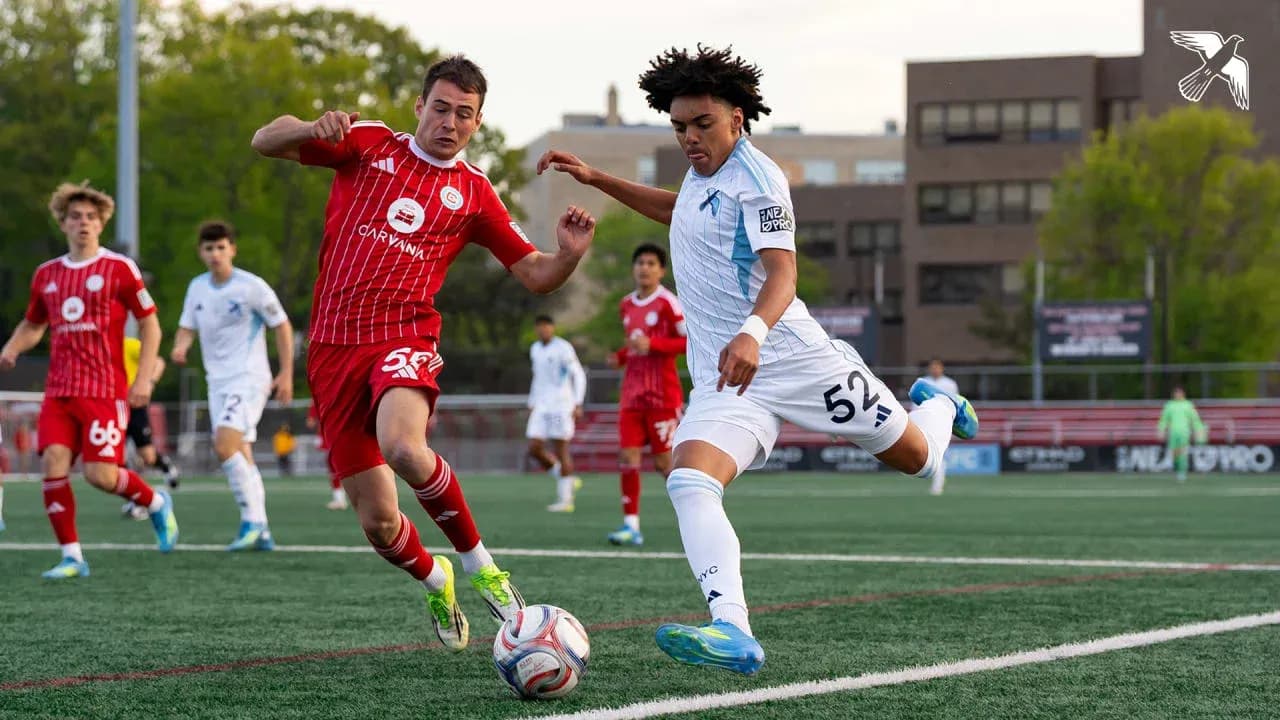
New York City II Edges Chicago Fire II in Tense MLS Next Pro Clash
Belson Stadium under the lights has a particular edge to it, and this group-stage clash in MLS Next Pro carried exactly that mood. New York City II, still feeling their way through the 2026 season, edged Chicago Fire II 2–1, a result that subtly reshapes the narrative for both squads.
I. The Big Picture – contrasting seasonal DNA
Following this result, the standings context sharpens the contrast between the two teams’ identities. New York City II came into the night with 9 points from 7 matches, ranked 6th in the Northeast Division and 12th in the Eastern Conference. Their overall goal difference was -5, built on 6 goals for and 11 against across all competitions listed, a profile of a side that concedes more than it creates but is far more dangerous at home.
The home/away split tells the story: heading into this game, New York City II had played 4 matches at home with 3 wins and 1 loss, scoring 5 and conceding 8. On their travels they had lost all 3, scoring just 1 and conceding 3. The season statistics reinforce this: at home they averaged 1.5 goals for and 2.0 against per game, while away they managed 0.3 goals for and 1.3 against. Belson Stadium, then, is both a platform and a crutch: they can win here, but they rarely win cleanly.
Chicago Fire II arrived with a more balanced but equally volatile profile: 10 points from 8 matches, ranked 6th in the Central Division. Overall they had 7 goals for and 11 against in the standings snapshot, a goal difference of -4. Season statistics add detail: across 8 fixtures they had scored 10 and conceded 12, with an average of 1.3 goals both for and against at home and away. They had no draws, a pure boom-or-bust side with 4 wins and 4 losses, and a biggest winning streak of 3.
This was, essentially, a meeting between a home-reliant, defensively fragile New York City II and a Chicago Fire II side that lives on knife-edge margins everywhere they go.
II. Tactical Voids and Discipline – living with risk
There were no listed absentees for either side, so both coaches had the luxury of full squads. Matt Pilkington leaned into that with an energetic, youthful XI: M. Learned, A. Campos, K. Acito, J. Suchecki, K. Smith, J. Shore, M. Carrizo, K. Pierre, H. Hvatum, S. Reid and A. Farnos formed a group built for vertical transitions rather than slow control.
Chicago Fire II, without a named coach in the data, mirrored that youth-driven volatility. J. Nemo, D. Nigg, C. Cupps, J. Sandmeyer, H. Berg, C. Nagle, O. Pineda, D. Villanueva, R. Turdean, D. Hyte and D. Boltz formed a spine that has already proved capable of both explosive winning runs and sudden collapses.
Discipline is a critical subplot for both. New York City II’s yellow card distribution this season is telling: 28.57% of their cautions come between 16–30', 14.29% between 46–60', and a striking 35.71% between 76–90'. There is also a red card spike in the 76–90' window, with 100.00% of their reds arriving late. This is a team that finishes games on the edge, emotionally and tactically.
Chicago Fire II spread their yellows more evenly: 10.00% between 16–30', then 20.00% in each of the 31–45', 46–60', 61–75' and 76–90' windows, plus another 10.00% between 91–105'. They have no red cards recorded. They are aggressive, but more controlled than their hosts, a useful trait in tight one-goal games like this 2–1.
III. Key Matchups – Hunter vs Shield, Engine Room
Without explicit top scorers listed, the “Hunter vs Shield” lens shifts from individuals to units. New York City II’s home attack, averaging 1.5 goals per game heading into this match, faced a Chicago Fire II away defence that conceded 1.3 goals on their travels. The home side’s biggest home win in the data was 2–1, which is exactly the pattern this game followed: they are at their best when they can trade punches but still land the final blow.
On the flip side, Chicago Fire II’s away attack had produced 5 goals in 4 away matches, an average of 1.3. That output met a New York City II home defence that was conceding 2.0 per game at Belson Stadium and had yet to keep a clean sheet anywhere this season. The visitors were always likely to score; the question was whether they could score enough.
In midfield, the “Engine Room” battle was less about named playmakers and more about unit cohesion. For New York City II, profiles like J. Shore and M. Carrizo symbolise the connective tissue between a back line that has already suffered a 0–5 home defeat and a front line that depends on quick service. K. Pierre and H. Hvatum offer the running power and pressing intensity that suit Pilkington’s willingness to accept chaos in exchange for territory.
Chicago Fire II’s central core – with players such as C. Nagle and O. Pineda – is built to shuttle, break lines and support second balls. Their season form line, “WLWWWLLL”, reads like a team that thrives when they can tilt the game into transition phases but struggles when forced into structured defending.
IV. Statistical Prognosis – xG logic and defensive solidity
We do not have explicit xG numbers, but the statistical profiles allow a reasoned approximation of expected trends. Heading into this game, New York City II’s total averages pointed to a 1.0 goals-for and 1.7 goals-against pattern per match overall, distorted by their away struggles. At home, the 1.5 for and 2.0 against suggested that any xG model would anticipate both teams scoring and the match trending over a single goal each.
Chicago Fire II’s symmetry – 1.3 goals for and 1.5 against overall, with identical 1.3 for at home and away – adds weight to that. On their travels they concede 1.3, New York City II at home score 1.5; Chicago Fire II away score 1.3, New York City II at home concede 2.0. The intersection points toward a high-likelihood “both teams to score” scenario and a projected xG balance somewhere near parity, perhaps with a slight home tilt due to NYC II’s strong home win rate (3 wins from 4).
Defensive solidity, or the lack of it, remains the defining concern for both. New York City II had failed to keep a single clean sheet in total, while Chicago Fire II managed 2 clean sheets overall but only 1 away. With New York City II also failing to score in 3 total matches and Chicago Fire II failing to score just once, the underlying probabilities favoured a narrow, scrappy contest where small details – late cards, tired legs, a single defensive lapse – would decide it.
A 2–1 home win fits that statistical script almost perfectly. New York City II once again leaned on Belson Stadium to mask their structural defensive issues, while Chicago Fire II’s all-or-nothing season continued with another knife-edge result, this time on the wrong side of the margin.
Related News

MLS Winners and Losers: Rising USMNT Star Cavan Sullivan, St. Louis City's Smart Moves, and Chicago Fire's Struggles Without Hugo Cuypers

MLS Highlights: Portland Timbers End Drought, Josh Sargent Shines, Cavan Sullivan Impresses
Tacoma Defiance vs Colorado Rapids II Stats: Head-to-Head Record

St. Louis City II vs Vancouver Whitecaps II: Head-to-Head Stats and Match Preview
Atlanta United II vs New York City II Stats: Head-to-Head Record
Houston Dynamo FC II vs Austin II Stats: Head-to-head Record