
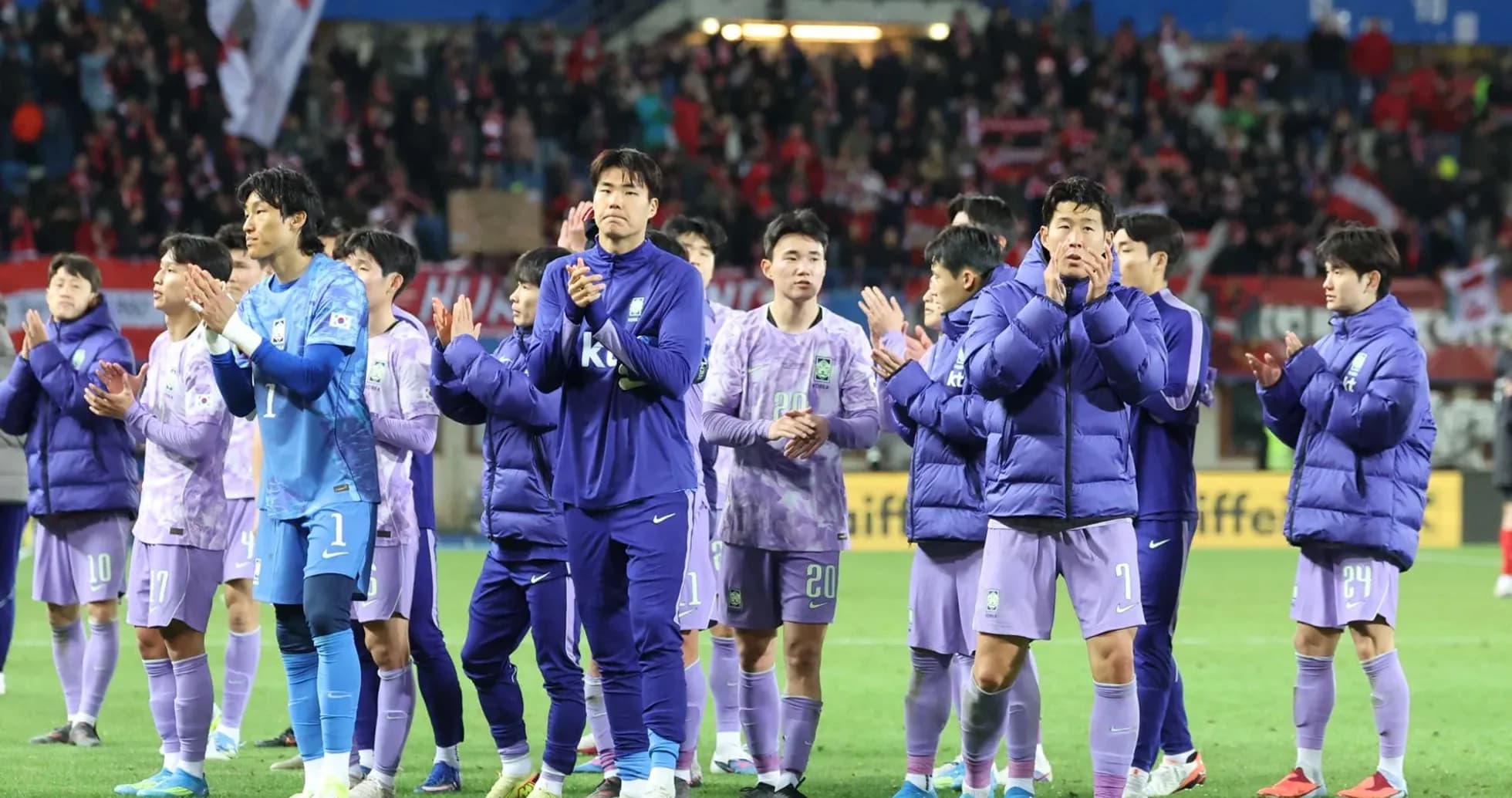
Korea's World Cup Journey: Expectations and Challenges Ahead
Thirty days from kickoff, Korea is heading to the biggest World Cup in history with a fan base that cannot decide whether to boo, stay home, or dare to believe.
The countdown has only amplified the unease. Since Hong Myung-bo’s controversial appointment in the summer of 2024, the Taegeuk Warriors have been playing under a cloud. The stadiums filled, as they always do for the men’s national team, but the soundtrack changed: relentless boos for Hong, banners demanding the resignation of Korea Football Association President Chung Mong-gyu, an atmosphere that felt more like protest than support.
Then came the quieter verdict. Empty seats.
On Oct. 14, just 22,206 fans turned up at the 66,000-seat Seoul World Cup Stadium for a friendly against Paraguay – the smallest crowd for a men’s international in a decade. A month later, 33,256 watched Korea host Ghana at the same venue. Respectable numbers on paper, but in a country used to full houses and feverish energy, they told their own story.
Korea won both games, either side of another unconvincing victory over Bolivia in Daejeon before roughly 33,000 supporters. The results looked tidy. The performances did not. The disquiet lingered.
Then 2025 arrived, and the results caught up with the mood. Korea opened their World Cup year with back-to-back away defeats: a 4-0 hammering by Ivory Coast on March 28, followed by a 1-0 loss to Austria three days later. Confidence, already fragile, sank further.
On paper, though, the draw has been kind. World No. 25 Korea landed in what many pundits regard as one of the softer groups: Group A with 15th-ranked Mexico, 41st-ranked Czechia and 60th-ranked South Africa. No traditional superpower. No obvious juggernaut. No excuse, some would argue.
The schedule offers its own small favors. Korea open against Czechia in Guadalajara at 8 p.m. on June 11 (11 a.m. on June 12 in Korea), then stay in the same city to face Mexico at 7 p.m. on June 18 (10 a.m. on June 19 in Korea), before traveling to Monterrey to meet South Africa at 7 p.m. on June 24 (10 a.m. on June 25 in Korea). Less travel, more continuity, and a base in Mexico while other teams crisscross three host nations: Mexico, Canada and the United States.
This is uncharted territory for everyone. A 48-team World Cup, expanded from 32, with 12 groups and a new round of 32. The top two from each group advance, joined by the eight best third-placed teams. The door to the knockouts has never been wider.
That is why so many experts insist Korea should clear the first hurdle without too much drama. What happens after that is far less clear.
This will be Korea’s 11th consecutive World Cup appearance. Away from home soil, they have reached the knockout rounds twice – in South Africa in 2010 and in Qatar in 2022. The pattern is familiar: steady presence, occasional breakthrough, lingering frustration over what might have been.
Television analyst Kim Dae-gil sees enough in this group to expect at least another run into the last 16.
“I think Korea will get to at least the round of 16,” Kim said. “Just looking at the group stage opponents, Korea won’t have to expend as much energy as in some previous tournaments. We can beat Czechia and South Africa six times out of 10. And if we qualify for the knockouts as the top seed or No. 2 seed, then we will meet a beatable opponent in the round of 32.”
His optimism rests on two familiar shoulders. Captain Son Heung-min, now with Los Angeles Football Club, and Paris Saint-Germain playmaker Lee Kang-in remain the team’s trump cards, the players who can tilt a game with a single touch.
Kim called them “game changers,” capable of conjuring chances from nothing. But even as he praised them, he pointed to the fault line that could crack Korea’s campaign.
“The gap between the starters and backups is substantial,” he said. “To reach beyond the round of 16, the team will need players who can support the regulars. It is imperative for the likes of Son Heung-min to stay healthy.”
Not everyone shares his faith.
Analyst Seo Hyung-wook started out believing this side could reach the round of 16. An injury changed his mind. He now expects Korea’s World Cup to end in the round of 32, largely because of the ankle problem suffered by midfielder Hwang In-beom.
Hwang, a clever two-way presence in the heart of midfield, is as close to irreplaceable as anyone in Hong’s squad. He injured his right ankle in March while playing for Feyenoord and is currently rehabbing with support from the national team’s medical staff. His fitness is no longer just a medical bulletin; it is a tactical question that hangs over the entire campaign.
“Other mainstays have not been playing well,” Seo said. “Lee Kang-in and Kim Min-jae (of Bayern Munich) have not been playing much for their clubs.”
The upside, in Seo’s view, lies in the understanding among the Europe-based core – Son, Lee, Kim and others who have built up years of familiarity.
“Korea’s strength will be the chemistry among Europe-based stars,” he said. “The problem is there just aren’t many of them. At this moment, I don’t think you could say anyone can play at a world-class level at the World Cup.”
Park Chan-ha, the third analyst, also expects Korea to bow out in the round of 32. His concern is less about names on a team sheet and more about what happens when the ball rolls.
“Hong Myung-bo’s team has some talented players,” Park said. “And yet, they often have trouble creating scoring chances. The team relies on players’ individual skills to try to capitalize on those few opportunities, but you can only do so much of that at the World Cup. I think we already saw problems with this approach in the two losses in March.”
If Hwang cannot play, or is limited, Park believes those problems will only deepen. The midfield, already under scrutiny, would lose its metronome and its shield.
So attention turns to the opener, and here the analysts split again – not on its importance, but on what it will mean.
“I think the first match against Czechia will be the most important one,” Park said. “This is the one Korea must win, and they will be in trouble if they don’t get it done. Czechia are not an offensive-minded team, and Korea may have difficulty breaking through their defense.”
Seo agreed on the weight of that first night in Guadalajara.
“In our World Cup history, the outcome of the first match often determined the fate for the rest of the tournament,” he said. “Mexico will be a tough test in the second match, and if we don’t win the first match, we will be in big trouble.”
Kim Dae-gil, though, looks at the calendar and circles a different date.
“I think Korea and Mexico will battle for the top spot in the group,” he said.
Between the boos at home, the soft draw abroad and the uncertainty over key players’ fitness and form, Korea walk into this World Cup on a knife-edge. The path to the round of 32 looks open. The question is whether this team can turn that opening into something more than another brief cameo on football’s biggest stage.
Related News

Raphinha’s Hat-Trick Powers Barcelona to 7-2 Victory Over Racing Santander
Carabao Cup Fourth Round Draw: Liverpool Set to Clash with Chelsea, Arsenal to Face Fleetwood Town
Key Football Matches to Watch in Azerbaijan This Autumn
Raphinha's Hat-Trick Drives Barcelona to 7-2 Triumph Over Racing Santander
Hansi Flick Leads Barcelona to Record-Breaking Seven Wins in a Row
Gavi Reflects on Injury Return as Barcelona Dominate Racing Santander 7-2