
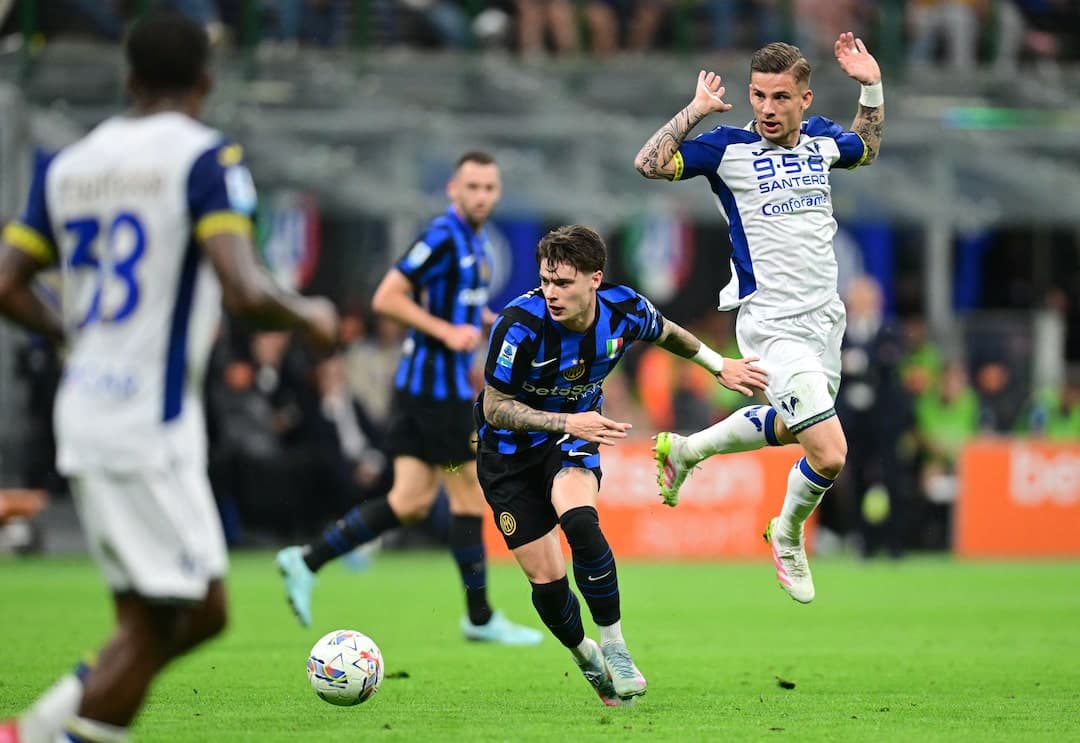
Inter Held to Draw by Hellas Verona in Serie A
Under the grey May sky of Milan, the Stadio Giuseppe Meazza staged a meeting that looked, on paper, like a mismatch and ended as a reminder of Serie A’s capacity for resistance. Inter, champions-elect in all but name and sitting 1st with 86 points and a towering goal difference of 54 (86 goals scored and 32 conceded overall), were held 1-1 by a Hellas Verona side marooned in 19th on 21 points and staring at relegation.
Following this result, the numbers still tell of two different universes. Inter’s season has been built on relentless control: overall they have 27 wins from 37 matches, scoring 2.3 goals per game and conceding just 0.9. At home they have been even more ruthless, with 14 wins from 19, 50 goals scored at an average of 2.6 per game and only 16 conceded (0.8 on average). Verona, by contrast, have crawled through the season: just 3 wins in 37, scoring 0.7 goals per match and conceding 1.6 overall. On their travels they have won only 2 of 19, scoring 13 and shipping 33.
Yet on this afternoon, Verona bent the script without breaking. Paolo Sammarco’s choice of a 5-3-2 at the Meazza was not an act of fear but of clarity. With D. Mosquera, G. Orban, D. Oyegoke and S. Serdar all listed as missing – injuries and inactivity stripping away depth and firepower – Verona arrived short-handed and chose to compress the pitch rather than chase it.
The tactical voids were most glaring in attack. Orban, their suspended spearhead in the disciplinary charts with 7 league goals and 1 red card this season, was absent through inactivity, forcing Sammarco to turn to T. Suslov and K. Bowie as the front two. Behind them, the midfield shield of R. Gagliardini, S. Lovric and A. Bernede carried an enormous workload, especially with another combative presence like J. Akpa Akpro only on the bench.
Inter, by contrast, had the luxury of rotation. Cristian Chivu kept faith with the season’s default 3-5-2 – a shape they have used in all 37 league games – but he shuffled personnel. Y. Sommer anchored a back three of M. Darmian, S. de Vrij and F. Acerbi, while the wing corridors were entrusted to Luis Henrique and Carlos Augusto rather than the league’s top assist provider F. Dimarco, who began among the substitutes despite his 16 assists and 6 goals this season. In midfield, A. Diouf, P. Sucic and H. Mkhitaryan formed a more experimental trio, with the creative metronome H. Çalhanoğlu and the all-action N. Barella also held in reserve.
Up front, however, there was no compromise. L. Martinez, the league’s top scorer with 17 goals and 6 assists in 29 appearances, led the line alongside the powerful A. Bonny. The message was clear: even with rotation, Inter expected to overwhelm a Verona defence that had conceded 59 goals overall, including 33 away.
From the opening whistle, the pattern was familiar. Inter’s back three stepped high, compressing Verona into their own third. Diouf and Sucic rotated in the half-spaces, while Mkhitaryan drifted between lines, looking to draw out Gagliardini and create pockets for Martinez. Yet Verona’s five-man defence – M. Frese, N. Valentini, A. Edmundsson, V. Nelsson and R. Belghali – formed a tight, horizontally compact chain in front of L. Montipò.
Frese, one of Verona’s most combative figures this season with 79 tackles and 10 successful blocks, set the tone on the left. He stepped aggressively into duels with Luis Henrique and Bonny, accepting the risk of cards that has defined his campaign (8 yellows). Gagliardini, who leads Verona with 10 yellow cards and 73 tackles, patrolled the central channel, repeatedly shutting down Mkhitaryan’s attempts to combine with Martinez.
The disciplinary profiles of both teams subtly shaped the contest. Inter, heading into this game, showed a tendency toward late yellow cards: 30.65% of their cautions arrive between 76-90 minutes, part of a broader late-game edge where their intensity often spikes as they close out matches. Verona, conversely, are volatile throughout the middle of games, with 23.26% of their yellows between 46-60 minutes and a striking 50.00% of their reds in the 76-90 window. That fragility forced Verona to defend on the edge but rarely over it here; they knew that going a man down at the Meazza would likely be fatal.
The “Hunter vs Shield” duel was always going to be Lautaro Martinez against Verona’s away defence. On their travels Verona concede 1.7 goals per game and have managed only 3 clean sheets away. Martinez, with 69 shots and 39 on target this season, attacks the box with ruthless volume. Yet Montipò and his line held firm for long stretches, Verona’s low block compressing the spaces where Martinez usually thrives. Without the crossing quality of Dimarco from the left or the deep orchestration of Çalhanoğlu, Inter’s supply was more predictable, and Verona could defend zones rather than individuals.
In the “Engine Room”, Chivu’s decision to start Diouf and Sucic instead of the established axis of Barella and Çalhanoğlu dulled Inter’s usual rhythm. Çalhanoğlu’s season numbers – 1393 passes with 41 key passes at 90% accuracy, plus 9 goals and 4 assists – illustrate how much he normally dictates tempo and progression. Barella, with 72 key passes and 8 assists, is the vertical accelerant. Without them from the first whistle, Inter’s possession sometimes circled rather than pierced, allowing Gagliardini and Lovric to hold their ground.
When the game tilted, it was often through moments rather than structure: a Martinez movement off the back shoulder, a Carlos Augusto underlap, or a rare Verona break where Suslov and Bowie tried to exploit the space behind Inter’s advanced wing-backs. But Verona’s broader offensive limitations, reflected in just 25 goals overall and 13 away at an average of 0.7 per away game, meant that even their counters lacked consistent punch.
From a statistical prognosis standpoint, Inter’s season-long xG profile – implied by their 2.3 goals per game and only 2 failures to score in 37 matches – would normally forecast a multi-goal home win against a defence as porous as Verona’s. Their 18 clean sheets overall, including 8 at home, underline a defensive solidity that usually allows their attack to win games by margin rather than by edge.
Yet football lives in the gap between probability and reality. Following this result, the narrative is of a Verona side that, stripped of key attacking pieces and burdened by a season of struggle, nonetheless found a way to slow the league’s most ruthless machine in their own cathedral. Inter’s depth and dominance remain unquestioned, but this 1-1 serves as a reminder: even a champion’s structure can be blunted when its sharpest creative tools sit on the bench and a desperate opponent, led by enforcers like Gagliardini and Frese, refuses to yield.
Related News
Frosinone vs Como Prediction: Key Stats and Betting Tips

Fiorentina vs Napoli Prediction: Key Stats and Betting Tips
AS Roma vs Inter: Serie A Showdown on 19 September 2026

Inter’s Dominance in 5–3 Win Over Udinese

AS Roma vs Inter Prediction: Key Stats and Betting Tips
Lazio and AC Milan Battle to a 2–2 Draw: Early Serie A Insights