
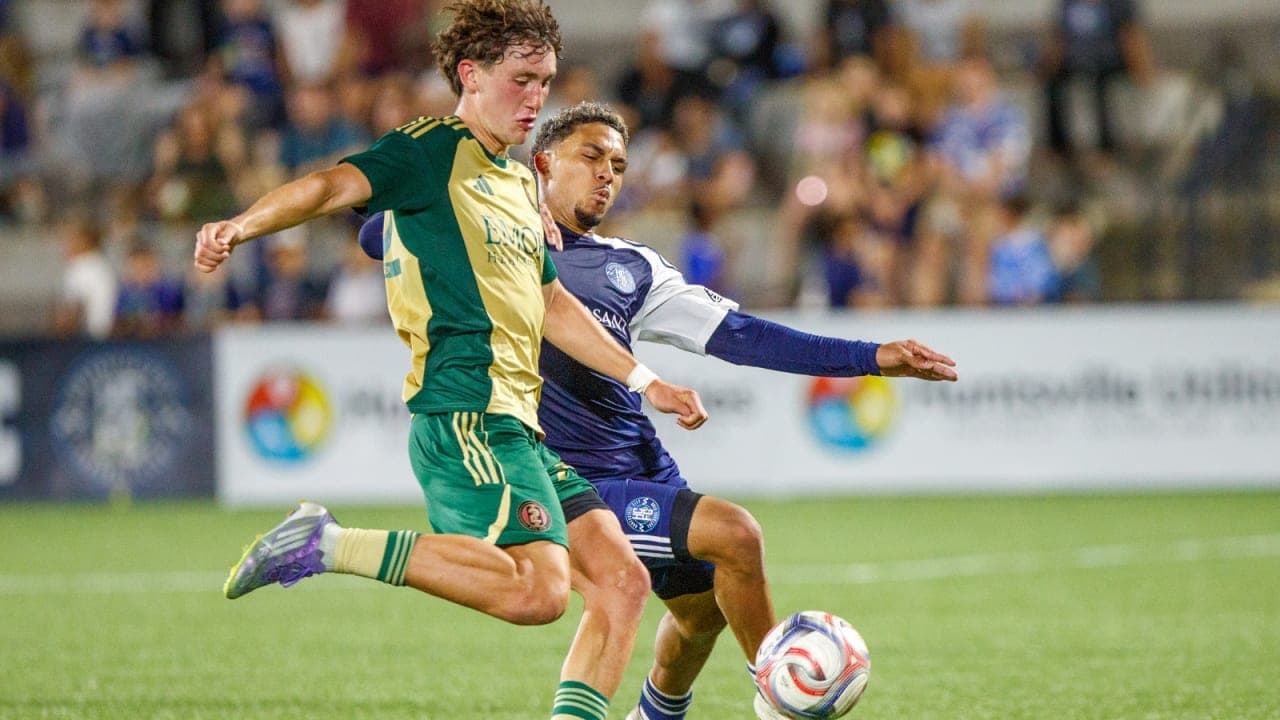
Huntsville City vs Atlanta United II: A Stunning 6-2 Defeat
Under the lights at Joe W. Davis Stadium, a Group Stage meeting in MLS Next Pro turned into something far more revealing than the bare numbers of the table. Huntsville City, sitting 3rd in the Central Division and 6th in the Eastern Conference heading into this game, were torn apart 6-2 at home by an Atlanta United II side that arrived as the division’s 2nd-placed team and left looking every inch a promotion contender.
The final scoreline cut sharply against the pre-match statistical grain. Huntsville City had built their early-season identity on chaos and firepower: in total this campaign they averaged 2.4 goals scored per match and 2.3 conceded, with 24 goals for and 23 against across 10 fixtures. At home they had been similarly wild, with 2.4 goals for and 1.8 against on average. Atlanta United II, by contrast, were the more balanced machine: in total this campaign they scored 2.0 goals per match and conceded just 1.4, with a goal difference of 6 (20 for, 14 against) that spoke to a side comfortable in control.
Yet for 45 minutes, Huntsville seemed to be writing a different script. They went into the break 2-0 up, leaning on the energy and verticality of a front unit led by L. Eke and the creative lines of M. Ekk and N. Pariano. The midfield pairing of M. Veliz and M. Yoshizawa tried to compress the pitch, stepping high to trap Atlanta’s build-up and force play into central turnovers. With X. Valdez anchoring from the back and the full-backs M. Molina and L. Christiano pushing on, Huntsville’s structure resembled a bold, front-foot 4-2-3-1, even if the official formation was not listed.
Second Half
The second half, however, was a brutal exposure of Huntsville’s structural fragility and emotional volatility. This was a team whose disciplinary profile had been flashing warning signs all season. In total this campaign, 30.77% of their yellow cards arrived between 76-90 minutes, with another 15.38% coming in the 91-105 window. Red cards were split evenly between 31-45 and 76-90 minutes. Huntsville are a side that frays late, and against an Atlanta team that grows into matches, that tendency became fatal.
Atlanta United II’s own yellow-card distribution is more evenly spread, but crucially they peak in the middle and late phases: 21.74% of their yellows arrive between 61-75 minutes and another 21.74% between 76-90. This is a team that is still contesting every duel deep into the match, and it mirrored their tactical profile here: patient early, then relentlessly assertive once Huntsville’s press lost its bite.
Without a named coach on the team sheet, Atlanta’s structure had to be read through the players. The starting core of J. Donaldson, I. Ettinger, M. Senanou and M. Cisset suggested a disciplined back line, with D. Chong-Qui and E. Dovlo likely tasked with shuttling between lines. In the “engine room”, A. Gill and A. Torres provided the connective tissue, linking the deeper build-up to the more expressive wide threats of M. Tablante and C. Dunbar, with A. Kovac offering a focal point.
The “Hunter vs Shield” duel in this fixture was always going to be Huntsville’s high-octane attack against Atlanta’s away defensive record. On their travels this campaign, Atlanta United II had conceded just 1.4 goals per match (10 against in 7 away games), while scoring 2.0. Huntsville’s home attack, averaging 2.4 goals per game, looked capable of cracking that shield — and for 45 minutes, they did. But once Atlanta found their rhythm after the interval, the match flipped: Huntsville’s high line and aggressive stepping from A. Talabi and L. Christiano became a liability, especially with the midfield tiring and the distances between lines growing.
Atlanta’s “engine room” superiority told. A. Gill and A. Torres repeatedly found pockets between Huntsville’s double pivot and back four, dragging Veliz and Yoshizawa into uncomfortable decisions: step out and leave space in behind, or hold and allow Atlanta to turn and drive. With M. Tablante and C. Dunbar stretching the width, the visitors repeatedly isolated Huntsville’s full-backs, forcing emergency defending that Huntsville’s season-long numbers suggest is not their strength. In total this campaign they had already conceded 23 goals; this 6-2 defeat at home now stands as their heaviest home loss, matching the 2-6 scoreline listed among their biggest defeats.
The bench options only deepened the contrast in game management. Huntsville turned to the likes of W. Mackay, K. Coulibaly, N. Prince and J. Van Deventer, fresh legs tasked with chasing a game that had slipped from their grasp. Atlanta, meanwhile, could call on P. Weah, L. Butts, D. Sibrian and M. Pineda to reinforce both structure and counter-attacking threat, allowing them to keep punishing Huntsville’s increasingly desperate shape.
From a disciplinary and psychological perspective, the match also aligned with the season-long trends. Huntsville’s late-game card surge often coincides with them chasing or protecting high-scoring results, and the collapse from 2-0 up to 2-6 down fits a profile of a side that struggles to modulate intensity. Atlanta, whose red cards in total this campaign are concentrated between 46-90 minutes, managed to stay on the right side of that aggression here, channeling it into duels rather than reckless challenges.
Following this result, the statistical prognosis for both squads sharpens. Huntsville City remain one of the league’s most entertaining but vulnerable outfits: in total this campaign they now sit at 24 goals scored and 23 conceded, with a goal difference of 1 that feels precarious given the volatility of their performances. Their penalty record — 1 taken, 1 scored, 100.00% conversion — shows clinical precision from the spot, but that is a small island of control in an otherwise turbulent defensive sea.
Atlanta United II, by contrast, look like a side whose underlying numbers and tactical habits are converging toward a promotion-ready identity. In total this campaign they have 20 goals for and 14 against, a goal difference of 6 built on a balance of away resilience and attacking clarity. Their ability to turn a 2-0 deficit into a 6-2 away win speaks not just to firepower, but to a collective belief in their structure and a fitness profile that allows them to dominate the decisive middle and late phases.
In a playoff context, this match reads like a warning and a promise. Huntsville’s attacking ceiling is high enough to trouble anyone in a one-off tie, but their defensive volatility and late-game disciplinary spikes could be ruthlessly exposed over knockout minutes. Atlanta United II, meanwhile, carry the look of a side whose xG and defensive solidity are trending in the right direction: not always spectacular from the start, but increasingly inevitable by the end.
Related News

MLS Winners and Losers: Rising USMNT Star Cavan Sullivan, St. Louis City's Smart Moves, and Chicago Fire's Struggles Without Hugo Cuypers

MLS Highlights: Portland Timbers End Drought, Josh Sargent Shines, Cavan Sullivan Impresses
Tacoma Defiance vs Colorado Rapids II Stats: Head-to-Head Record

St. Louis City II vs Vancouver Whitecaps II: Head-to-Head Stats and Match Preview
Atlanta United II vs New York City II Stats: Head-to-Head Record
Houston Dynamo FC II vs Austin II Stats: Head-to-head Record