
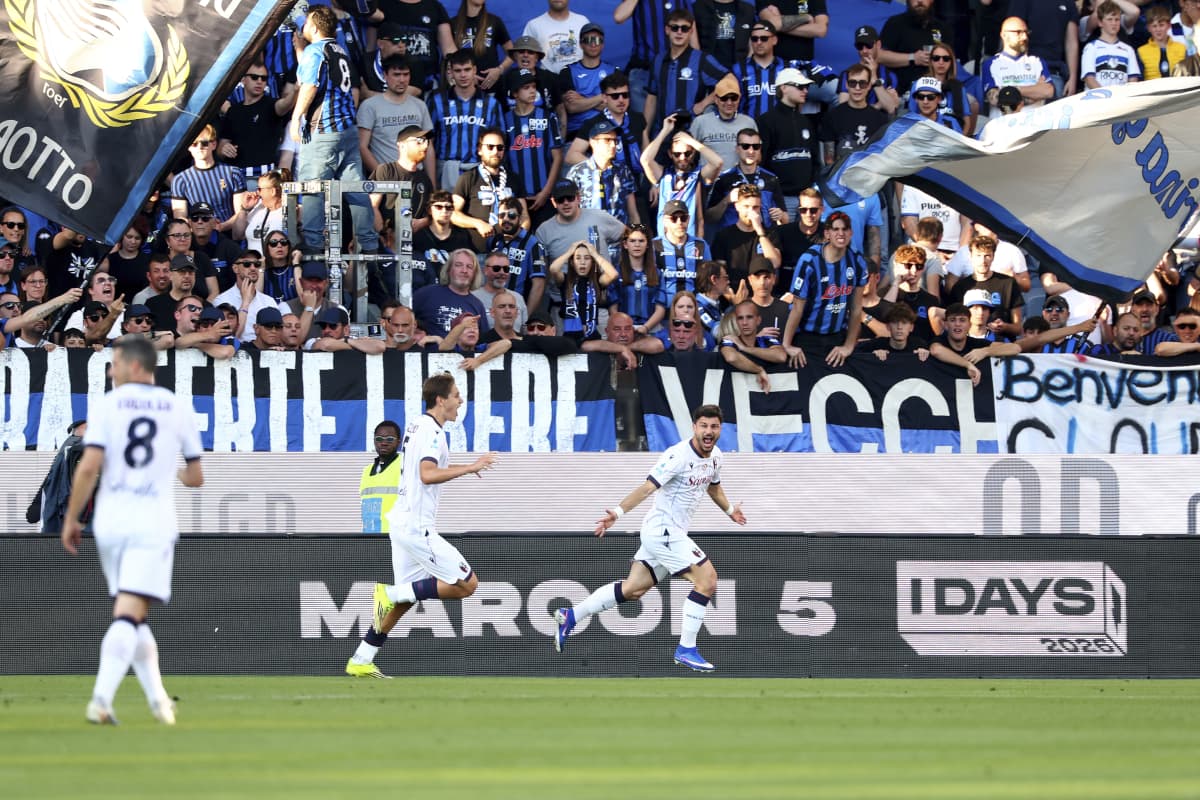
Atalanta vs Bologna: Tactical Analysis of a 0–1 Defeat
The New Balance Arena closed its afternoon under a grey Bergamo sky and a 0–1 scoreline that said as much about Bologna’s clinical edge as it did about Atalanta’s blunted attacking structure. Following this result, the table tells a story of two neighbours separated by fine margins: Atalanta in 7th on 58 points, Bologna in 8th on 55, both having played 37 matches. But the tactical currents beneath that surface reveal why Vincenzo Italiano’s side were able to tilt a tight Serie A contest their way.
I. The Big Picture – Structure vs. Steel
Atalanta arrived with the season-long DNA of a controlled aggressor. Overall this campaign they have scored 50 goals and conceded 35, a goal difference of +15 built on balance rather than chaos. At home they have averaged 1.3 goals for and 0.8 against, a profile of a side that usually leans on defensive solidity and controlled territorial pressure rather than wild shootouts.
Raffaele Palladino doubled down on that identity with a 3-4-2-1: M. Carnesecchi behind a back three of G. Scalvini, B. Djimsiti and H. Ahanor, wing-backs D. Zappacosta and N. Zalewski stretching the width, M. De Roon and Ederson patrolling the centre, with C. De Ketelaere and G. Raspadori supporting focal point N. Krstovic.
Bologna, by contrast, have lived this season as a split personality: functional at home, ruthless on their travels. Away they have averaged 1.6 goals scored and 1.2 conceded, taking 10 wins from 19 away matches. Italiano’s choice of a 4-3-3 – L. Skorupski in goal, a back four of Joao Mario, E. Fauske Helland, T. Heggem and J. Miranda, a midfield of L. Ferguson, R. Freuler and T. Pobega, and a front three of F. Bernardeschi, S. Castro and J. Rowe – was a statement: this would not be a low block and a prayer; it would be structured aggression.
The final scoreline, 0–1 to Bologna, fits their away-season template: efficient, slightly risk-accepting, but underpinned by enough defensive order to survive.
II. Tactical Voids – Absences and Discipline
Both coaches had to stitch around absences that subtly reshaped the match.
Atalanta were without L. Bernasconi (knee injury), I. Hien (suspended for yellow cards) and O. Kossounou (thigh injury). The loss of Hien, in particular, removed a first-choice defensive reference in the back line. That thrust more responsibility onto Scalvini and Djimsiti to defend open spaces, especially when the wing-backs pushed high. It also made Palladino more cautious with his line height, mindful that any misstep would expose Ahanor on the outside of the three.
Bologna’s absentees were even more concentrated in the heart of their usual defensive spine. K. Bonifazi (inactive), N. Cambiaghi (muscle injury), N. Casale (calf injury), J. Lucumi (yellow-card suspension) and M. Vitik (ankle injury) stripped Italiano of depth and continuity at centre-back and in wide attacking rotations. Yet the chosen back four held, thanks in part to Freuler’s positional discipline in front of them.
Season-long disciplinary trends also framed the risk landscape. Atalanta’s yellow cards peak late: 24.14% of their bookings arrive between 76–90 minutes, with another 22.41% between 61–75. Bologna mirror that volatility, with 26.87% of their yellows between 61–75 and 25.37% between 76–90. This match was always likely to tighten into a nervy, foul-heavy finale, and the structure of both midfields – De Roon and Ederson for Atalanta, Freuler and Ferguson for Bologna – was designed as much to manage transitions as to create.
III. Key Matchups – Hunter vs Shield, Engine Room
The headline duel was always going to be N. Krstovic against Bologna’s defensive block. Heading into this game, Krstovic had 10 league goals and 5 assists, built on 75 total shots (34 on target) and a physical, duel-heavy style – 267 duels contested, 117 won. He is less a pure poacher and more a reference point who thrives on service and second balls.
Bologna’s answer was collective rather than individual. Without Lucumi and Casale, Italiano relied on the pairing of E. Fauske Helland and T. Heggem to stay tight on Krstovic, while Freuler screened passes into his feet. The wide defenders, Joao Mario and Miranda, narrowed aggressively whenever the ball entered zone 14, daring Atalanta to find width and crosses rather than clean vertical combinations.
Behind them, Skorupski’s season-long record of 12 clean sheets for Bologna overall (7 at home, 5 away) underlined a team comfortable protecting narrow leads. In Bergamo, that mentality translated into calm handling of crosses and a refusal to spill second balls into dangerous central areas, neutering Atalanta’s attempts to swarm on knockdowns.
In the “engine room”, the contest between creators and enforcers was more nuanced. For Atalanta, C. De Ketelaere arrived as a quiet orchestrator: 997 passes this season with 62 key passes and 5 assists, operating between the lines. His job was to drag Freuler or Ferguson out of shape, opening half-spaces for Raspadori and the wing-backs. But Bologna’s central trio stayed compact. Freuler’s reading of play – honed in this very stadium in another shirt – repeatedly cut off De Ketelaere’s preferred left half-space, forcing him wider and deeper.
On the other side, Bologna’s primary “hunter” on the season has been R. Orsolini, with 10 goals and 1 assist, plus 66 shots (31 on target). He started on the bench here, but his profile loomed over Atalanta’s defensive planning: a left-footed threat who can attack the right side of Atalanta’s back three. The mere presence of Orsolini among the substitutes allowed Italiano to threaten a late, direct outlet if Atalanta overcommitted.
IV. Statistical Prognosis – Why 0–1 Felt Inevitable
Strip away the narrative, and the numbers frame this as a plausible outcome. Overall, Atalanta average 1.4 goals for and 0.9 against per match; Bologna sit at 1.2 for and 1.2 against. On their travels, Bologna’s 30 away goals from 19 matches, against 23 conceded, mark them as one of the league’s more dangerous away sides.
Atalanta’s home profile – 25 scored, 15 conceded across 19 games – suggests a team that usually keeps things tight. Their 13 clean sheets overall and only 9 total defeats underline a side that rarely collapses, but their 8 matches failing to score, including 6 at home, hint at an occasional creative drought when early chances do not fall.
Bologna, meanwhile, have failed to score in 11 league games overall, but only 3 times away. That away resilience, combined with their comfort in narrow matches and a penalty record that is perfect in total (5 scored from 5, with 0 missed), builds a picture of a side that maximises small windows of opportunity.
Without explicit xG data, the expected goals story must be inferred: Atalanta, structured but sometimes sterile, versus a Bologna team that creates fewer but higher-quality away chances and is used to protecting slim leads. In that light, a 0–1 away win feels like the statistical median of their profiles rather than an upset.
Following this result, the narrative is of Atalanta’s possession and structure meeting a blue-and-red wall that refused to crack, and a Bologna side whose travelling identity – compact, opportunistic, and quietly ruthless – once again dictated the final line of the scoreboard.
Related News
Frosinone vs Como Prediction: Key Stats and Betting Tips
Fiorentina vs Napoli Prediction: Key Stats and Betting Tips

AS Roma vs Inter: Serie A Showdown on 19 September 2026

Inter’s Dominance in 5–3 Win Over Udinese
AS Roma vs Inter Prediction: Key Stats and Betting Tips
Lazio and AC Milan Battle to a 2–2 Draw: Early Serie A Insights