
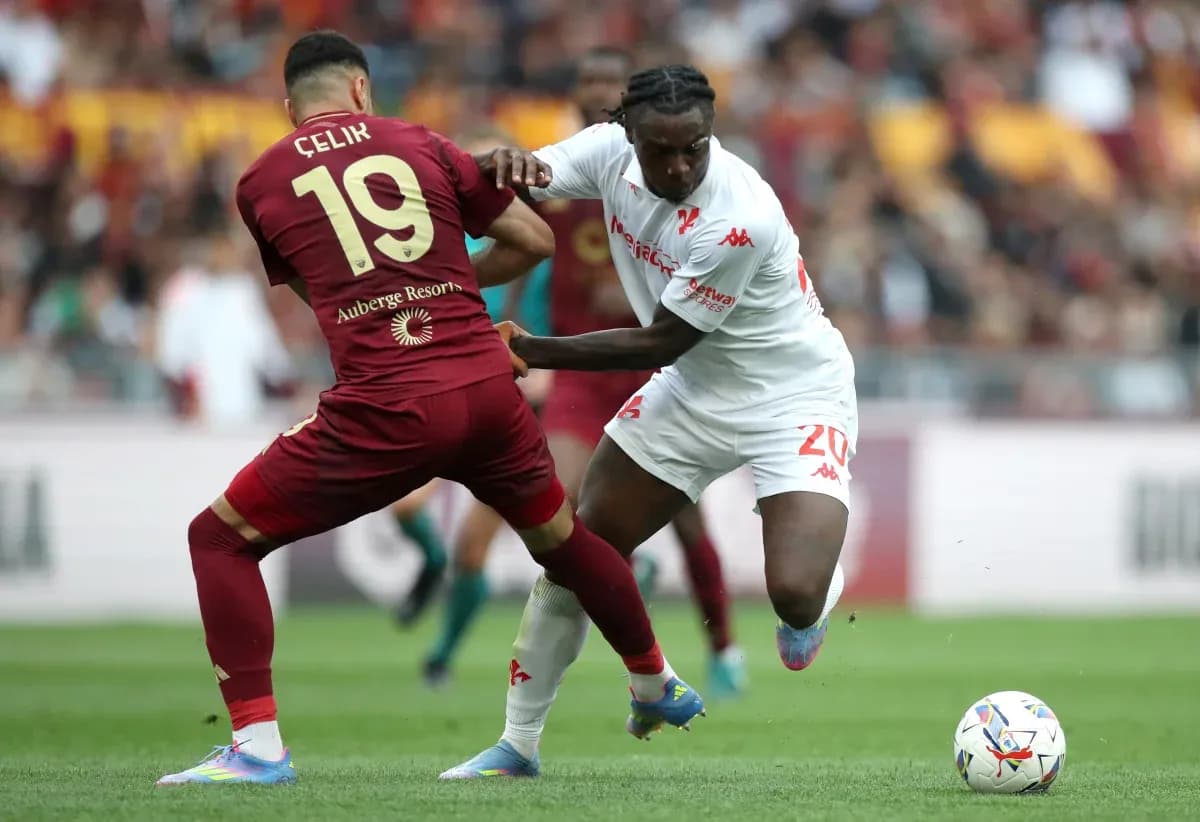
AS Roma Dominates Fiorentina 4-0: A Serie A Statement
Under the lights of the Stadio Olimpico, this Serie A regular season clash in Round 35 ended as a statement win: AS Roma 4–0 Fiorentina, a result that crystallised the contrasting trajectories of a side chasing Europe and another still glancing over its shoulder.
Heading into this game, Roma were already shaped by their seasonal identity: a compact, three-at-the-back machine that had turned the Olimpico into a fortress. At home they had played 18 league matches, winning 12, drawing 3 and losing only 3. The home attacking average of 1.7 goals per game, married to just 0.6 goals conceded at home, underpinned a formidable home goal difference of +21 (31 scored, 10 conceded). Overall, their campaign goal difference of +23 (52 for, 29 against) had them sitting 5th on 64 points, very much in Europa League territory.
Fiorentina arrived in Rome with a different story. On their travels they had played 18 times, winning 4, drawing 6 and losing 8, scoring 18 and conceding 29 for an away goal difference of -11. Those numbers mirrored their overall goal difference of -11 (38 scored, 49 conceded) and a 16th-place standing on 37 points. Their season had been one of narrow margins and late collapses, with an away defensive average of 1.6 goals conceded per match and just 1.0 scored.
I. The Big Picture: Shapes and Intent
Piero Gasperini Gian doubled down on Roma’s season-long blueprint with a 3-4-2-1. M. Svilar anchored a back three of G. Mancini, E. Ndicka and M. Hermoso. Wide, Z. Celik and Wesley Franca were tasked with stretching Fiorentina and pinning back their full-backs, while N. Pisilli and M. Kone formed the central hinge. Ahead of them, M. Soule and B. Cristante operated as twin raumdeuters behind lone striker D. Malen.
Paolo Vanoli’s Fiorentina matched up with a 4-3-3, a shape that promised width but demanded bravery. D. de Gea stood behind a back four of Dodo, M. Pongracic, L. Ranieri and R. Gosens. The midfield trio of M. Brescianini, N. Fagioli and C. Ndour was built to circulate and resist Roma’s press, while J. Harrison and M. Solomon flanked A. Gudmundsson in a fluid front line.
The scoreline at half-time – 3–0 to Roma – told the story of a match that was effectively over by the interval. Roma’s season-long habit of turning home advantage into early control was amplified; Fiorentina’s fragility away from home was brutally exposed.
II. Tactical Voids: Absences and Discipline
Roma’s squad sheet was scarred by notable absences. A. Dovbyk (groin injury), E. Ferguson (ankle injury), L. Pellegrini (thigh injury) and B. Zaragoza (knee injury) were all listed as Missing Fixture, with N. El Aynaoui suspended through yellow cards. That stripped Gasperini Gian of a classic penalty-box focal point in Dovbyk and a key creative and leadership presence in Pellegrini. The response was telling: Roma leaned into mobility and interchangeability between Malen, Soule and Cristante, rather than traditional hold-up play.
Fiorentina’s own attacking depth was thinned. M. Kean, their top league scorer with 8 goals and a relentless duelist (228 duels, 102 won), missed out with a calf injury. R. Piccoli (muscle injury), T. Lamptey (knee injury), L. Balbo (injury) and N. Fortini (back injury) further limited Vanoli’s rotation options. Without Kean’s vertical threat and ability to occupy centre-backs, Fiorentina’s 4-3-3 lacked a true reference point to stretch Roma’s back three.
On the disciplinary front, both teams carried reputations into the fixture. Roma’s season yellow-card distribution showed a pronounced spike between 46–60', 61–75' and 76–90', each window accounting for 23.08% of their yellows. Red cards had come only in the 46–60' and 61–75' ranges. Fiorentina, by contrast, were a late-game risk: 25.00% of their yellows arrived between 76–90', with both of their league red cards also in that same late window. In a match where Fiorentina were chasing from early on, that late-game volatility was always likely to be a factor, even if the contest was effectively settled long before stoppage time.
III. Key Matchups
Hunter vs Shield
D. Malen entered this fixture as one of Serie A’s sharpest forwards: 11 league goals and 2 assists in just 15 appearances, with 40 shots and 24 on target. His efficiency in the box, backed by 2 penalties scored from 2, made him the natural spearhead of Roma’s attack.
His primary obstacle was a Fiorentina defensive unit anchored by M. Pongracic, the league’s leading yellow-card collector with 11 bookings. Pongracic had been statistically robust – 29 tackles, 23 blocked shots, 34 interceptions and 91% passing accuracy – but his 66 fouls committed betrayed a defender often living on the edge. Alongside him, L. Ranieri, with 8 yellows and 22 fouls committed, offered aggression but also risk.
Malen’s movement across the front line, supported by Soule and Cristante, constantly dragged this centre-back pairing into uncomfortable zones. With Fiorentina already conceding an away average of 1.6 goals per game, the combination of Roma’s 1.7 home goals per match and Malen’s form created a structural mismatch that the 4–0 scoreline simply confirmed.
The Engine Room
In midfield, the game’s rhythm hinged on Roma’s hybrid double pivot of Pisilli and Kone against Fiorentina’s Brescianini–Fagioli–Ndour trio. Yet the true creative fulcrum was M. Soule, Serie A’s 10th-ranked assister with 5 assists and 6 goals in 30 appearances. Soule’s 43 key passes and 918 total passes at 83% accuracy marked him out as Roma’s primary conduit between lines, equally comfortable drifting wide or dropping into half-spaces.
Soule’s direct opponent in many sequences was C. Ndour, a young midfielder asked to shuttle and screen in front of Fiorentina’s back four. But the more subtle duel was between Soule’s craft and Fiorentina’s collective defensive habits: a side whose overall defensive average of 1.4 goals conceded per game, and whose late-game card surge, suggested structural rather than individual issues.
Behind Soule, G. Mancini and Z. Celik offered Roma steel and edge. Mancini, with 50 tackles, 13 successful blocks and 44 interceptions, is as much a defensive organiser as a disruptor, while Celik’s 57 tackles and 226 duels (113 won) underline his role as an aggressive wing-back. Their presence allowed Soule and Cristante to take risks higher up, safe in the knowledge that transitions would be managed.
IV. Statistical Prognosis: Why 4–0 Made Sense
Following this result, Roma’s season-long numbers and Fiorentina’s away profile aligned almost perfectly with what unfolded. A home side averaging 1.7 goals scored and 0.6 conceded at the Olimpico dismantled a visitor conceding 1.6 away and scoring just 1.0. Roma’s overall goal difference of +23 was built on exactly this kind of control: 1.5 goals scored per game in total against just 0.8 conceded.
Fiorentina’s -11 overall goal difference, and particularly their away goal difference of -11 (18 scored, 29 conceded), pointed toward vulnerability when forced to open up. Without Kean to stretch Roma vertically, and with Gudmundsson – a creative forward who has already taken a red card this season – needing to both create and finish, Vanoli’s side lacked balance.
In Expected Goals terms, the pre-match indicators would have leaned heavily toward Roma: a high-volume, efficient home attack against a porous away defence, and a Fiorentina side that has failed to score in 7 away fixtures this campaign. Roma’s defensive solidity, reflected in 16 clean sheets overall (10 at home), made a Fiorentina goal unlikely once the hosts seized early control.
The 4–0 scoreline was not an outlier, but the logical intersection of Roma’s structured aggression, Fiorentina’s away frailties and the absences that stripped the visitors of their most direct striker. At the Olimpico, the numbers and the narrative converged – and Fiorentina were swept away.
Related News
Fiorentina vs Napoli Prediction: Key Stats and Betting Tips
AS Roma vs Inter: Serie A Showdown on 19 September 2026
Inter’s Dominance in 5–3 Win Over Udinese
AS Roma vs Inter Prediction: Key Stats and Betting Tips
Lazio and AC Milan Battle to a 2–2 Draw: Early Serie A Insights
AC Milan vs Lecce Stats: Head-to-Head Record and Historical Context